

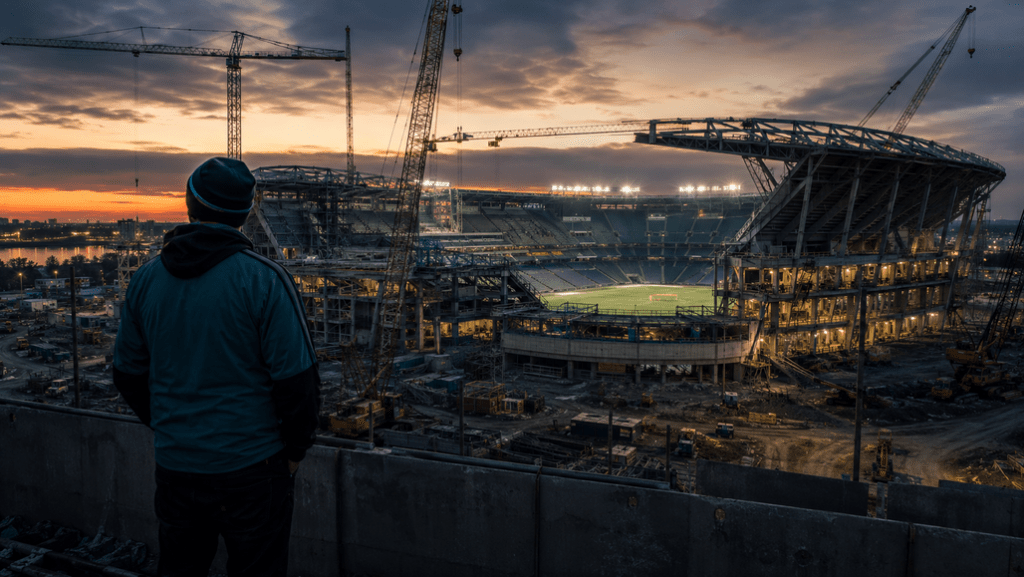
The Jacksonville Jaguars’ $1.4 billion EverBank Stadium renovation is more than a construction project. It is a football operations test that will stretch across three competitive seasons, reshape the team’s home schedule, and force Jacksonville to redefine what home-field advantage means before the renovated “Stadium of the Future” is scheduled to be ready in August 2028.
The team’s own project page says the City of Jacksonville and the Jaguars are transforming the existing stadium rather than replacing it, to keep the Jaguars, the Florida-Georgia game, and the TaxSlayer Gator Bowl in a modernized downtown venue that can also attract soccer matches and concerts through a stadium renovation plan. The football question is sharper: can the Jaguars protect their edge while playing through reduced capacity in 2026, a full temporary move to Orlando in 2027, and a return to a rebuilt Jacksonville home in 2028?
Why The Renovation Changes More Than The Building
Home-field advantage is usually discussed as crowd noise, travel comfort, climate, and routine. The Jaguars’ renovation affects all four. EverBank Stadium will remain the team’s Jacksonville home in 2026, but the construction schedule limits the available crowd. The Jaguars’ stadium FAQ lists the 2026 capacity at 42,465 seats, with games hosted outside Jacksonville only for the 2027 season as construction continues.
That reduced capacity matters because Jacksonville has spent years trying to make EverBank feel less like a neutral NFL stop and more like a difficult AFC South trip. A smaller building can still be loud, but it changes ticket scarcity, crowd composition, and the weekly energy around downtown. The fans inside may be more concentrated, but the team loses some of the raw scale that comes from a full stadium.
The 2027 shift is even more disruptive. NFL owners approved Camping World Stadium in Orlando as the Jaguars’ temporary home for the 2027 season, with the team unable to play at EverBank Stadium because of ongoing renovation work. The Jaguars announced that the renovated stadium is expected to be ready as their permanent home in time for the 2028 regular season, following the official Orlando stadium approval.
That means the Jaguars’ real home-field edge before 2028 will depend on how well the franchise preserves continuity while the building changes around the team.
The 2026 Season Becomes A Scarcity Test
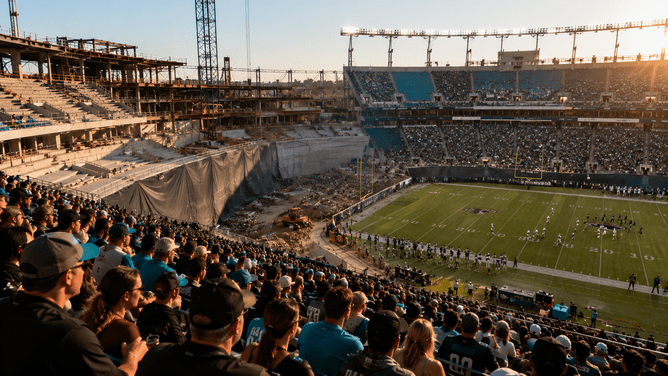
The 2026 season may be the most unusual part of the transition because the Jaguars will still be in Jacksonville, but not in a normal version of EverBank Stadium. Team president Mark Lamping said in February that the club would play two preseason games and six regular-season games at EverBank Stadium in 2026, while two home games would be played in London as part of the construction-era schedule, according to the Jacksonville Daily Record’s 2026 schedule update.
That creates a strange competitive mix. On one hand, six regular-season games in Jacksonville give the team a chance to hold onto local rhythm. Players still practice in their normal market. Fans still build game-week routines. Opponents still deal with Florida heat and travel to Jacksonville.
On the other hand, fewer Jacksonville home dates increase pressure on each one. If the Jaguars are chasing a playoff spot, a reduced home slate means less room to waste the games that still feel fully local. A normal eight- or nine-game home schedule spreads emotional weight across the season. A six-game local regular-season slate makes every Jacksonville date feel heavier.
For a franchise trying to build consistent success, that matters. The football calendar is built on rhythm, and construction breaks rhythm. FloridaFootballLive.com often looks at how individual decisions shape broader football identity, from campus offense stories to Miami Hurricanes offense analysis. The Jaguars are dealing with a similar identity issue at the NFL level: they need to keep Jacksonville feeling like home while the physical home is partly unavailable.
Orlando, in 2027, Could Expand The Fan Base Or Dilute The Edge
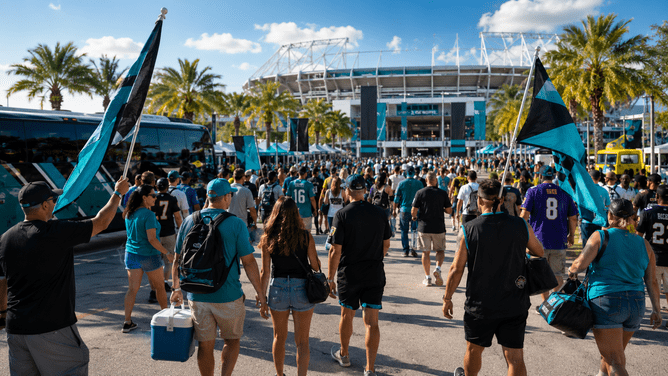
The 2027 move to Camping World Stadium gives the Jaguars a chance to reach a wider Florida audience. Orlando is not Jacksonville, but it is still inside the state, within driving distance for many Jaguars fans and closer to Central Florida supporters who may not regularly attend games at EverBank Stadium. That could give the team a rare statewide branding opportunity.
The risk is that a temporary home can feel temporary in every way. Travel routines change. Local tailgating culture changes. Season-ticket habits change. Opposing fans may find Orlando easier to reach, especially if the opponent has a national fan base or a strong Florida transplant following.
Camping World Stadium is undergoing its own major upgrade. Local Orlando reporting has described a $400 million renovation plan tied to expanded seating and improved infrastructure, with the venue positioned to handle the Jaguars’ temporary stay and other major events. That makes the setup more credible from a logistics standpoint, but stadium quality alone does not automatically reproduce home-field advantage.
The Jaguars will need to make Orlando feel like a Jaguars environment rather than a borrowed neutral site. That means game presentation, ticket distribution, fan events, supporter sections, and local marketing will matter. The team cannot assume that teal jerseys in a Florida stadium create the same pressure as a packed Jacksonville Sunday.
The New Stadium Could Solve Jacksonville’s Climate Problem
The long-term upside is real. The Jaguars’ stadium plan includes a shade canopy, improved airflow, expanded concourses, lookout decks, and wider event capability. HOK, the design firm involved in the project, said construction has advanced through a phased approach, with the Jaguars playing at reduced capacity in 2026, relocating for 2027, and targeting a 2028 opening for the renovated venue through the stadium construction update.
The canopy is the football detail that could change the most. Jacksonville heat has always been part of the home equation, but extreme discomfort can affect both sides. A shaded stadium may improve fan attendance, reduce empty-seat visuals, and keep crowd energy stronger late in games. If the building becomes more comfortable without losing the outdoor Florida feel, the Jaguars could create a better version of their existing advantage.
Expanded concourses and improved points of sale may sound like fan-experience details, but they can affect atmosphere. Fans who spend less time stuck in lines and more time in seats make the stadium louder. Easier circulation keeps the building from feeling drained after halftime. Better shade and airflow keep supporters engaged in September and October, when heat can turn a home game into an endurance test.
That is where the renovation could help Jacksonville most. The goal is not just to make EverBank look modern. The goal is to keep more fans present, louder, and more comfortable for four quarters.
What The Timeline Means For The Jaguars’ Competitive Window
The Jaguars’ competitive window and stadium timeline are now linked. If the roster is strong in 2026, the team has to capitalize despite fewer Jacksonville home games. If the roster peaks in 2027, that season will unfold away from EverBank Stadium. If the franchise is building toward 2028, the renovated stadium could become part of a larger relaunch.
That timeline puts pressure on coaching, travel planning, and roster maturity. Veteran players usually handle disrupted routines better than young rosters, but younger teams can adapt quickly if the staff controls details. The Jaguars’ performance across 2026 and 2027 may depend less on one dramatic adjustment and more on small operational habits: consistent practice weeks, controlled travel, familiar locker-room setups, and clear messaging around where “home” actually is.
The NFL side of the approval process also matters. The league’s 32 owners unanimously approved Orlando as the Jaguars’ 2027 home during the 2026 Annual Meeting, which gives the franchise a fixed planning runway. Uncertainty is often more damaging than inconvenience. Now that the location is set, the Jaguars can plan ticketing, travel, training rhythms, and fan engagement well ahead of time.
| Season | Home-Stadium Situation | Football Impact |
|---|---|---|
| 2026 | EverBank Stadium remains active with reduced capacity | Fewer seats, fewer Jacksonville regular-season home dates, higher pressure on local games |
| 2027 | Jaguars play home games at Camping World Stadium in Orlando | Temporary statewide reach, but a less familiar weekly environment |
| 2028 | Renovated EverBank Stadium expected to be ready | Chance to rebuild a stronger home-field identity with better comfort and amenities |
The challenge is not surviving one awkward season. It is managing a three-year transition without letting the team’s local edge go soft.
Why The Renovation Could Strengthen Jacksonville After The Disruption
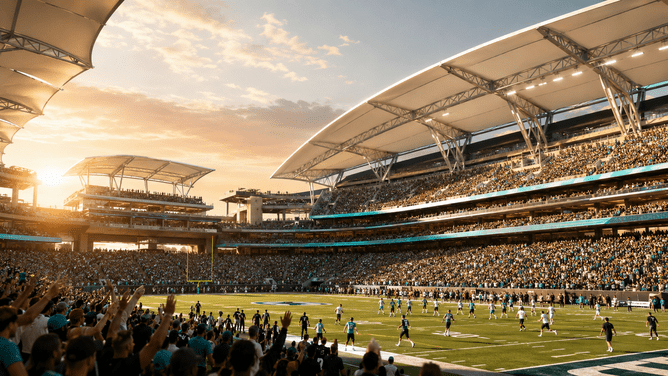
The best-case version of this project is easy to see. Jacksonville absorbs the reduced 2026 slate, turns the Orlando season into a statewide fan-building year, then returns in 2028 to a stadium that is louder, cooler, more comfortable, and better connected to downtown.
That would change the Jaguars’ home-field edge from a traditional local advantage into something more layered. EverBank could become a stronger event venue. The Florida-Georgia game and Gator Bowl would have a modernized home. The Jaguars could sell recruits, free agents, sponsors, and fans on a more serious football environment. Jacksonville could present itself less like a small-market team trying to keep up and more like a franchise that finally matched its facilities to its ambitions.
The downside is just as clear. If 2026 feels diminished and 2027 feels detached, the Jaguars could lose some of the emotional grip that makes NFL home fields matter. A team can return to a beautiful building and still need time to rebuild habits. Fans have to feel like they were carried through the construction period, not simply asked to wait for the finished product.
That is why the next two seasons are so important. The $1.4 billion renovation may be judged by architecture in 2028, but the football impact starts before the ribbon is cut. The Jaguars need to protect crowd identity, competitive routine, and local loyalty while the stadium is still a construction site.
If they do, Jacksonville’s home-field edge may not disappear during the renovation. It may come back sharper, more comfortable, and more valuable when the new EverBank Stadium opens for the next era.