

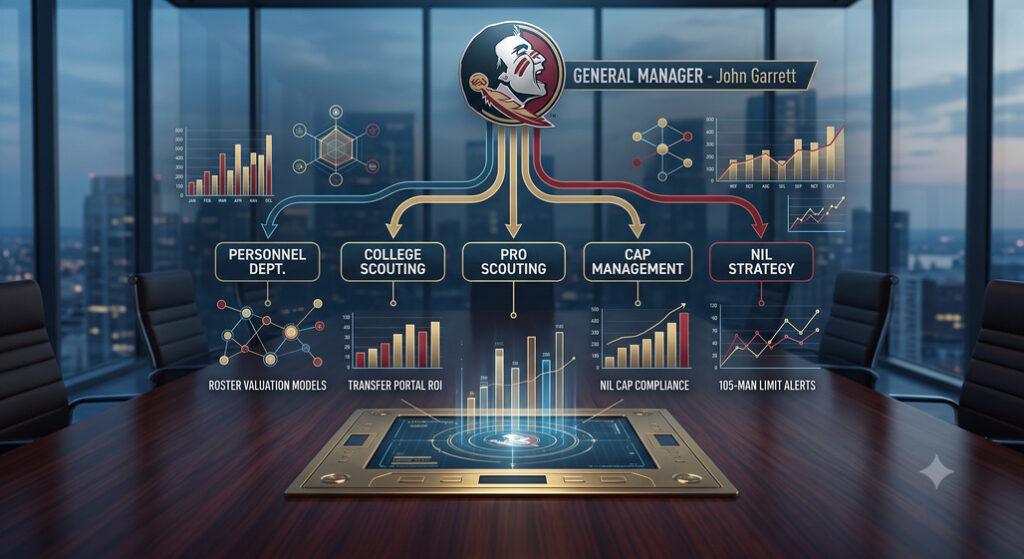
The Florida State Seminoles have officially moved away from traditional collegiate recruiting models, pivoting to a purely professional framework to manage player acquisition and retention. Following a severe 7-17 stretch over the 2024 and 2025 seasons, head coach Mike Norvell and Athletics Director Michael Alford recognized that coaching talent alone could no longer overcome structural deficiencies in roster building. The solution was an aggressive financial commitment to a professionalized personnel department, headlined by the return of John Garrett as the Deputy Athletics Director and General Manager of Player Personnel.
This restructuring is a direct mathematical response to the changing economics of college football. By securing Garrett with a three-year contract averaging $600,000 annually—double the salary of previous personnel directors in Tallahassee—Florida State is treating its roster like an NFL franchise operating under a hard salary cap. The focus is no longer just on securing commitments from high school athletes; it involves strict asset valuation, transfer portal ROI, and aggressive cap management ahead of impending NCAA structural changes.
The Financial Framework of the Restructure

The Florida State front office restructure extends far beyond Garrett. The program has committed nearly $1.5 million in early front-office salaries, adding Taylor Edwards as Executive Director of Football and Player Acquisition on a two-year deal starting at $400,000, alongside specialized directors like Joe Manion for college scouting.
This capital allocation shifts the burden of evaluation away from the on-field coaching staff. In traditional models, position coaches split their time between game-planning and scouting hundreds of high school and portal prospects. Under Garrett’s NFL-style system, the front office acts as a filtering mechanism. The scouting department assigns a strict monetary and strategic grade to a player before the coaching staff ever reviews the tape. This creates a massive competitive advantage regarding resource management. Coaches can strictly coach. At the same time, the general manager dictates where the NIL budget is deployed to maximize win probability.
Florida State’s front office must operate within the strict parameters of market value. If a portal defensive tackle demands a top-tier NIL package, Garrett and Edwards must cross-reference that demand against the player’s advanced metrics, injury history, and the team’s internal depth chart to determine if the ROI justifies the expenditure.
Roster Bloat and the Impending 105-Man Limit
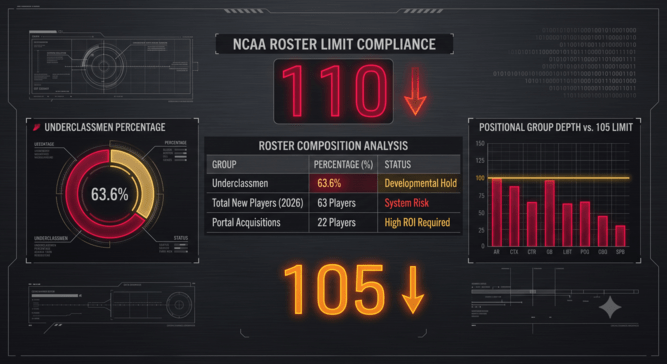
The immediate test for Garrett’s evaluation model is correcting the numerical imbalances within the Seminoles’ locker room. Florida State is currently carrying a bloated roster of 110 players, a figure that must be aggressively trimmed to comply with the impending 105-man roster limits slated to hit college football.
The composition of this roster presents significant cap management hurdles. The current breakdown highlights a team heavily reliant on young, unproven talent and an influx of new faces attempting to learn Norvell’s system simultaneously.
| Roster Metric | Current Figure | Strategic Implication |
| Total Roster Size | 110 Players | Requires cutting or transferring 5 players to meet future caps. |
| Underclassmen Percentage | 63.6% | High developmental burden; requires veteran portal acquisitions to balance. |
| Total New Players (2026) | 63 Players | Chemistry and system implementation risks are elevated. |
| Portal Acquisitions | 22 Players | Immediate impact required to justify NIL expenditures. |
Managing a roster where 63.6% of the athletes are underclassmen requires precise calculation. The front office cannot simply process out young players without damaging long-term development, but they cannot afford to carry non-contributing veterans on high NIL salaries. Garrett’s background in the NFL, including his time managing personnel structures and passing games with the Dallas Cowboys, provides the exact analytical framework needed to categorize these 110 players into core assets, developmental holds, and expendable pieces.
You can review a deeper breakdown of how certain positional groupings fit into this equation by examining the addressing the Seminoles defensive gaps ahead of the fall camp.
Mitigating Risk on Key Acquisitions
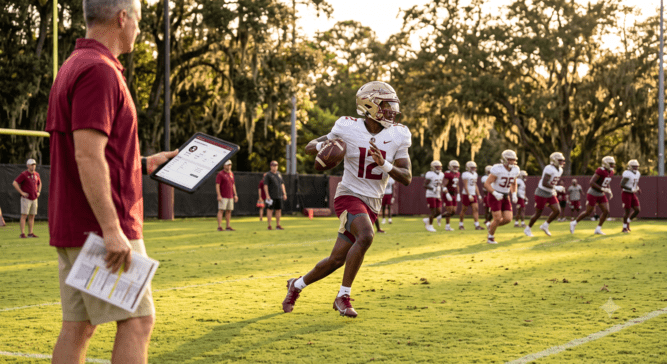
The success of the Florida State front office restructure will largely be judged by its hit rate in the transfer portal. The modern portal is an inflated market, and poor evaluations lead to dead cap space—wasted NIL money that yields zero on-field production.
A primary example of this risk mitigation is the evaluation of incoming transfer quarterback Ashton Daniels. The coaching staff requires a baseline level of pressure recognition and processing speed to operate the offense. In a traditional setup, the desperation for a quarterback might cause a staff to overlook analytical red flags in favor of raw arm talent.
Garrett’s front office operates differently. By running portal quarterbacks through professional scouting models that grade tight-window throw percentage, success rate on third down, and sack avoidance, the front office provides an objective baseline. They eliminate the emotional bias of recruiting. This guarantees that the NIL investment in a player like Daniels matches his expected analytical output, shielding the program from overpaying for average production.
To see how these evaluations are becoming the standard across the sport, one only needs to look at the national shift toward dedicated personnel departments and how top-tier programs are allocating their administrative budgets.
The Long-Term ROI of Front Office Independence
The real value of John Garrett’s strategy will materialize during the winter transfer window. By establishing an independent scouting department now, Florida State is building a database of scouting on thousands of college players. When a player enters the portal in December, Florida State will already have a grade, a projected market value, and a fit analysis ready.
This speed of execution is where the $600,000 salary pays for itself. Teams that lag in front office development will be forced to react to portal entries, scrambling to evaluate tape and formulate NIL offers. Florida State will be executing pre-planned acquisitions.
The Seminoles are betting heavily that their recent on-field struggles were a byproduct of inefficient roster construction rather than coaching failures. The addition of Garrett, Edwards, and a fully staffed scouting department is a clear signal that Florida State is treating the management of NCAA roster limits as a Wall Street transaction. If the data models hold and the evaluations are accurate, this front office restructure will serve as the financial engine that drives Florida State back to the top of the ACC betting markets.