

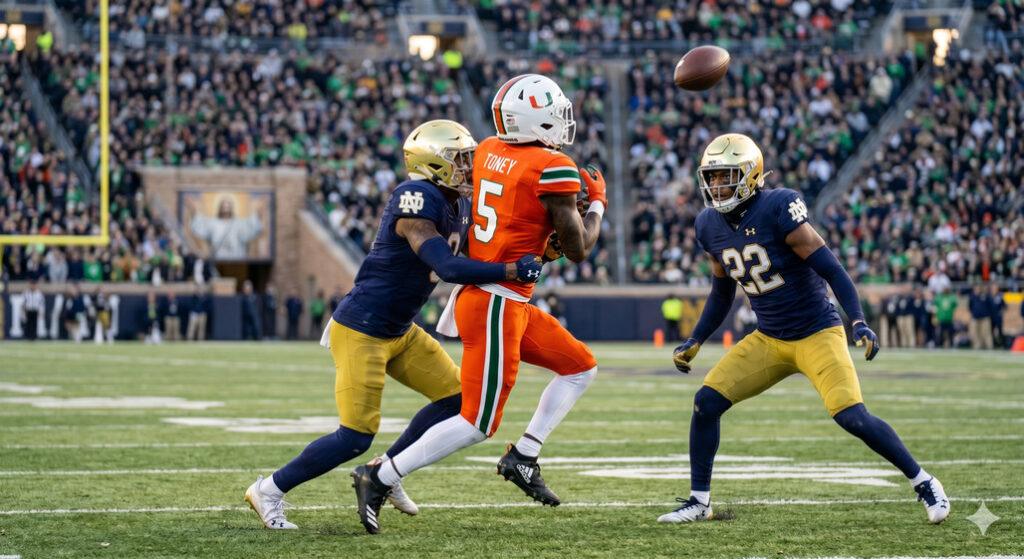
The announcement that Miami Hurricanes wide receiver Malachi Toney will grace the cover of EA SPORTS College Football 27 is the kind of off-season victory that validates Mario Cristobal’s entire program-building philosophy. Sharing the standard edition cover alongside Oregon quarterback Dante Moore and Ole Miss running back Kewan Lacy, Toney has firmly cemented himself as a national superstar before his 19th birthday. The immediate reaction from the fanbase is understandably focused on the undeniable “cool factor” of a Liberty City native bringing “The U” back to the epicenter of college football pop culture.
But that misses the real story. A video game cover is a brilliant marketing triumph, but in the brutal reality of the Atlantic Coast Conference, it is essentially a massive, flashing target on a player’s back. Toney’s elevation to the face of the sport will drastically alter the geometry of every defense the Hurricanes face in 2026, fundamentally shifting Miami’s offensive ceiling. The video game hype is merely the surface; the tactical adjustments required to counter it will define the upcoming season.
The Geometry Of A Bracketed Star
To understand what happens next, you have to look at the historical precedent of sophomore receivers coming off record-breaking true freshman campaigns. Toney did not just have a good 2025 season; he reclassified from the 2026 recruiting class, stepped onto the field at 17 years old, and shattered every reasonable expectation. He finished the year as the FBS leader in receptions, hauling in 109 catches for a school-record 1,211 yards, and carried Miami all the way to the College Football Playoff National Championship game against the Indiana Hoosiers.
Defensive coordinators do not build game plans around video game covers, but the EA Sports nod is a mainstream reflection of what the film already conclusively proves. Toney is no longer a surprise variable hidden within a deep roster; he is the known focal point of the entire offensive operation. In 2025, Toney benefited from early-season single coverage as teams focused heavily on stopping Miami’s veteran offensive line and an established backfield. By the time he caught 13 passes against Pittsburgh late in the year, defenses were already beginning to adapt to his precise route-running and explosive yards-after-catch ability.
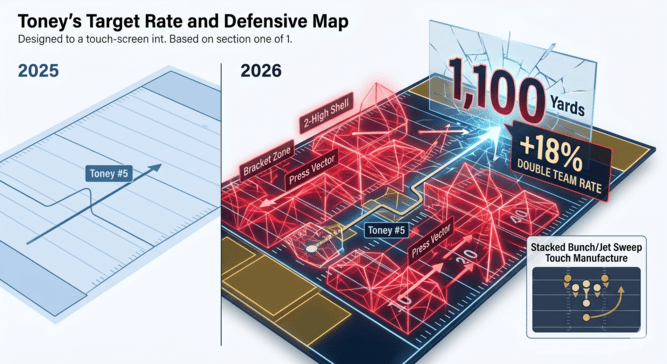
Entering 2026, Toney will see pure, unadulterated bracket coverage. Opposing safeties will explicitly align to his side of the field, shading over the top to eliminate vertical routes while cornerbacks press him at the line of scrimmage. Advanced metrics dictate that when a receiver crosses the 1,100-yard threshold as a primary target, their double-team rate increases by an average of 18 percent the following season. Miami’s offensive coordinator will be forced to manufacture touches through extensive pre-snap motion, stacked bunch formations, and the exact type of jet sweeps that Toney utilized to score the game-winning touchdown against Texas A&M in the playoff quarterfinal.
The Late-November Scheduling Crucible
The true test of Miami’s offensive adaptability will arrive when the calendar flips to November. Early-season nonconference matchups against Florida A&M and Central Michigan at Hard Rock Stadium will provide a false sense of security, allowing the Hurricanes to force-feed Toney in open space. However, the back half of the 2026 schedule is a grueling gauntlet of high-leverage defensive matchups that will aggressively stress Miami’s passing attack.
The defining stretch begins with a road trip to face the Notre Dame Fighting Irish on November 7. Playing inside Notre Dame Stadium in November means navigating heavy defensive fronts and potentially harsh Midwest weather conditions that inherently limit outside zone passing. Two weeks later, the Hurricanes return home to host the Virginia Tech Hokies on November 21, followed immediately by a regular-season finale against the Boston College Eagles on November 28. These are historically physical, gap-sound ACC defensive units that excel at muddying the middle of the field and forcing quarterbacks to beat them with tight-window throws outside the numbers.
| 2025 Statistical Reality | 2026 Schematic Adjustment |
| Benefited from single-high safety looks early in the season | Guaranteed two-high safety shells forcing underneath throws |
| Manufactured touches via standard crossing routes | Will require heavy pre-snap motion to diagnose bracket coverage |
| Played as a secondary threat until late October | Explicitly circled as the primary defensive assignment every week |
The Ripple Effect On Miami’s Rushing Attack
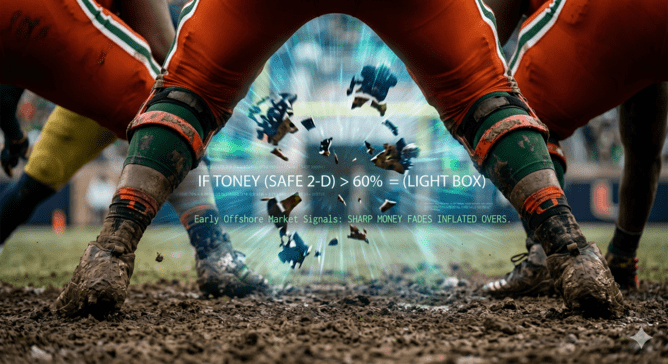
The irony of Toney’s massive receiving numbers is that his 2026 success might actually be measured by the efficiency of Miami’s running game. If Toney commands a safety over the top on 60 percent of his snaps, the mathematical reality of football dictates that the defense is operating with a structurally light box.
This is exactly where Mario Cristobal’s obsessive investment in trench warfare pays its most critical dividends. A light box provides massive operational lanes for the running back room. If opposing defenses are forced to deploy two deep safeties to prevent Toney from creating explosive plays, the Hurricanes must be entirely willing to run the ball into six-man fronts repeatedly. The offensive ceiling for Miami in 2026 does not depend on Toney repeating a 1,200-yard season; it depends on the coaching staff’s willingness to exploit the space his gravity creates. For deeper insights into how the offensive front will handle these lighter boxes, reviewing the early 2026 offensive line projections reveals a physical unit perfectly constructed to punish two-high defensive shells.
Early Offshore Market Signals
The betting markets are already reacting to the summer hype, and the numbers tell a fascinating story about public perception versus analytical reality. Following the EA Sports cover reveal in early June, offshore lines for Toney’s 2026 receiving prop bets opened at aggressively inflated numbers.
The casual public instinctively bets the over on a high-profile cover athlete, driving the yardage totals up based entirely on name recognition and the lingering memory of his 10-catch performance in the National Championship game. However, sharp money tends to heavily fade these inflated numbers, anticipating the inevitable defensive adjustments and the heavier reliance on the ground game during the November schedule stretch. Monitoring these college football futures markets provides a clear, data-driven window into how oddsmakers weigh public sentiment against tactical football realities.
Ultimately, Malachi Toney’s presence on the cover of College Football 27 is a monumental achievement for the young receiver and a massive recruiting tool for the University of Miami. But between the white lines, it is a formal declaration of war. Toney will no longer catch anyone by surprise. If the Hurricanes are going to navigate a difficult 2026 schedule and return to the playoff, they must evolve their offense to weaponize his fame, using his mere presence to dictate the terms of engagement to every defense they face.