

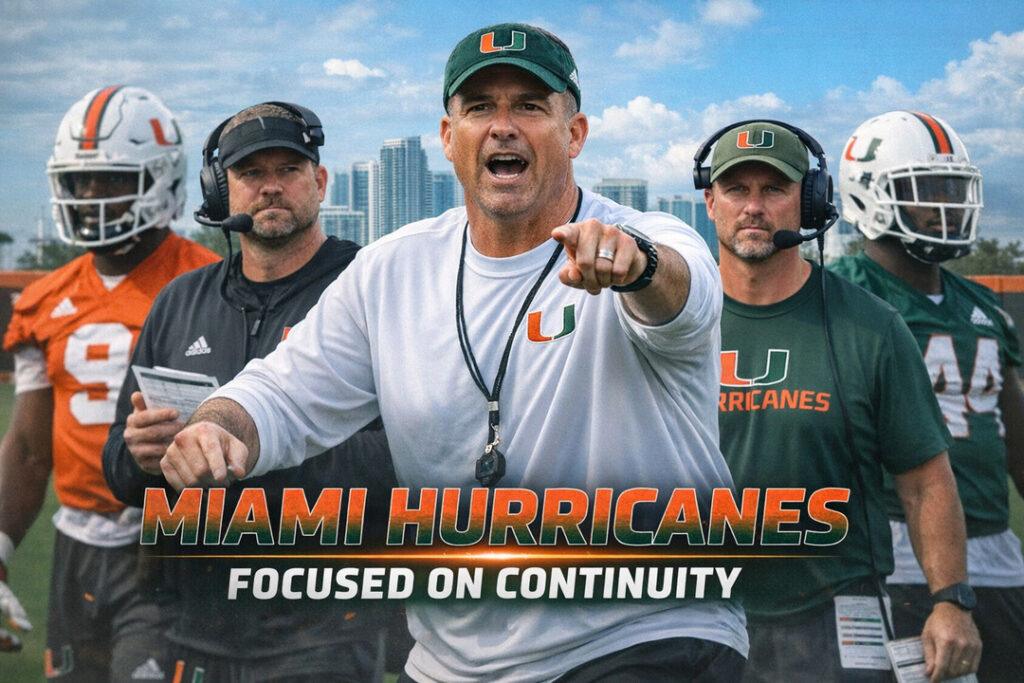
The most revealing thing about Miami this spring is not a quarterback controversy, a flashy transfer, or a radical schematic shift. It is something quieter and, in many ways, more significant: the program’s determination to protect what already works.
After a grueling 16-game campaign that ended on the sport’s biggest stage, Miami has reached the point where stability itself carries value. That is why Miami Hurricanes football feels especially relevant right now. The question entering 2026 is no longer whether the Hurricanes can build a contender. It is whether they can preserve a championship-caliber structure while managing the wear, expectations, and scrutiny that follow a playoff run.
Continuity Has Become Miami’s Defining Spring Story
If I had to identify the central theme of Miami’s offseason in one word, it would be continuity.
Programs that break through nationally often face an immediate secondary challenge: success tends to invite disruption. Assistants become attractive candidates elsewhere. Systems are picked apart. Players carry heavier physical and mental mileage. Momentum can harden into pressure. Miami appears to understand that dynamic clearly, and this spring the program has acted as though its most important job is to avoid unnecessary turbulence.
That is what makes the retention of offensive coordinator Shannon Dawson and defensive coordinator Corey Hetherman so meaningful. It signals a broader institutional decision to keep the architecture intact. Rather than chasing novelty, Miami is leaning into familiarity, language continuity, and system preservation. For a team coming off a long season, that is not a passive choice. It is an aggressive one.
The real edge for Miami may be that it does not need reinvention. It needs sharper execution inside a framework players and coaches already trust.
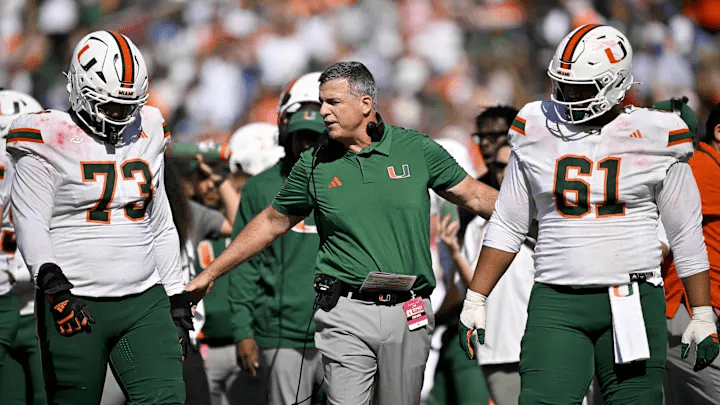
A Long Season Has Changed The Way Miami Approaches Spring
Spring football is usually treated as a season of construction. For Miami, it has looked more like one of calibration.
That distinction matters. Teams coming off ordinary seasons often use spring to install, experiment, and overhaul. Miami’s recent history has pushed it into a different category. The workload from a 16-game season creates consequences that do not disappear when the calendar flips. Recovery becomes part of strategy. Conditioning has to be adjusted. The tempo of preparation must reflect not only ambition but accumulated physical stress.
I see that as one of the most mature elements of Miami’s current approach. The program is not behaving like a team desperate to prove it belongs. It is acting like one that understands the cost of staying near the top. Health management, workload moderation, and a measured ramp-up are not soft priorities. They are competitive necessities.
That matters because the easiest mistake for a playoff-caliber team is to chase offseason intensity for its own sake. Miami’s spring suggests a more disciplined mindset: conserve what must be preserved, sharpen what needs refinement, and arrive in the fall healthier than many contenders do.
The Strategy Is Refinement, Not Reinvention
What stands out most when I look at Miami’s current trajectory is how little appetite there seems to be for a philosophical reset. This is not a program sending out signals of identity confusion. It is not trying to become something entirely different in April.
Instead, Miami appears to be working within a more sophisticated premise: the next step is not to redesign the machine, but to make it run cleaner.
That applies to both sides of the ball. Offensively, continuity with Dawson means Miami can spend less time re-teaching structure and more time honing rhythm, timing, and situational detail. Defensively, keeping Hetherman in place allows Miami to build on existing communication and tactical understanding rather than restarting terminology and responsibilities. Across a roster, that kind of continuity adds up. Repetition becomes more useful. Corrections become more precise. Practice time stretches further.
The strategic picture becomes clearer in a simple comparison:
| Area Of Focus | What Miami Is Prioritizing | Why It Matters |
|---|---|---|
| Coaching Structure | Keeping both coordinators in place | Preserves terminology, philosophy, and continuity |
| Player Management | Recovery and controlled spring workload | Reduces attrition risk after a long season |
| Team Development | Refining execution instead of overhauling identity | Maximizes gains from an already proven model |
This is the kind of offseason plan that can look understated from the outside while carrying enormous internal significance.
Final Week Of Spring Tells Its Own Story
The timing of Miami’s spring also reinforces the point. Entering the final week of practice, the emphasis has been less about unveiling a new version of the Hurricanes and more about tightening the details that separate very good teams from elite ones.
That final phase of spring can often reveal a staff’s real priorities. When a program is still searching for itself, the language tends to revolve around experimentation and open-ended competition. When a program knows what it wants to be, the conversation shifts toward polishing, sequencing, and making sure every layer functions under pressure.
Miami feels like the second kind of team right now.
I do not read that as complacency. I read it as conviction. The Hurricanes are operating like a team that believes the formula is already sturdy enough to win at a high level. The challenge is to protect that formula from erosion while improving the margins that matter most in championship football: health, precision, and week-to-week consistency.
The Biggest Questions Still Facing Miami
Continuity does not erase uncertainty. It simply changes the nature of the questions.
The most important issues surrounding Miami now are not existential. They are more subtle, and arguably more difficult:
- Can the Hurricanes preserve urgency when stability makes spring feel less dramatic?
- Will the benefits of continuity outweigh the natural wear of a season that ran deep into winter?
- Can Miami turn familiarity into sharper execution rather than mere comfort?
Those are serious questions, but they are the kind strong programs want to have. They reflect a team operating from strength, not scrambling for solutions.
Why This Matters Right Now
Miami’s spring story matters because it offers a revealing snapshot of where the program stands in the modern college football cycle. Many teams spend the offseason trying to become relevant. Miami is spending this one trying to remain formidable.
That is a harder assignment than it sounds. Success creates instability as often as it creates confidence. Staff retention, player recovery, and tactical continuity are not side notes to the 2026 season. They are central to whether Miami can sustain its rise rather than simply relive it.
From where I sit, that is the clearest takeaway of this moment. Miami has entered the offseason with the discipline of a contender that understands how fragile momentum can be. The Hurricanes are not chasing a new identity. They are protecting a valuable one. And in April, that may be the smartest sign yet that this program intends to matter again when the games truly count.