

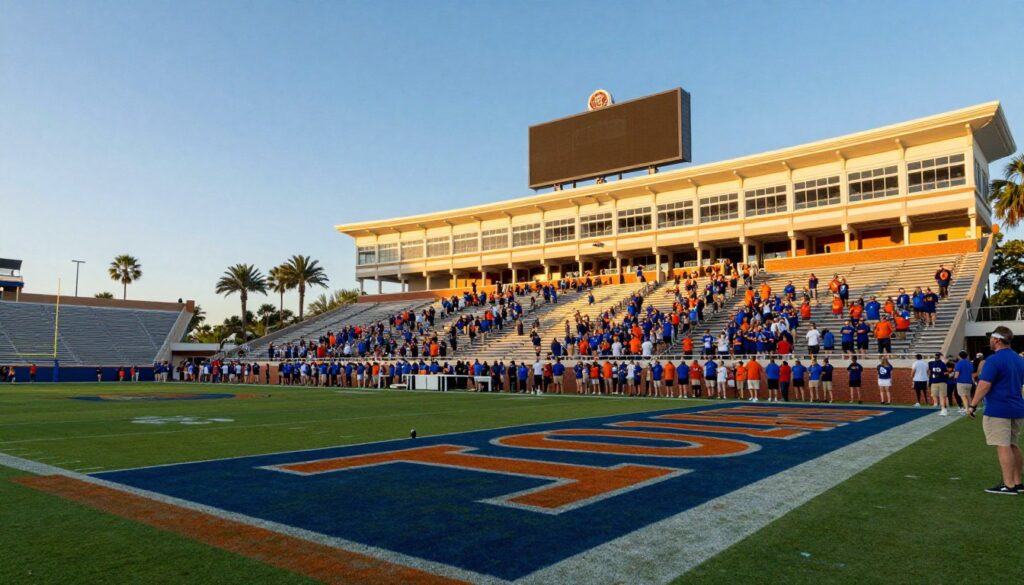
Welcome to the Sunshine State, where the ground beneath our hallowed gridirons is as fluid as a politician’s promise. I’m not talking about the literal swampy substrate of Gainesville. This is about naming rights.
The chronicle of Florida’s football cathedrals is a masterclass in commercial rebranding. Hard Rock Stadium has had nine different names in its lifetime. It’s enough to give a fan an identity crisis.
This phenomenon isn’t isolated to Miami Gardens. AmericanAirlines Arena became the FTX Arena overnight. loanDepot park and the BB&T Center also changed names. Even ghosts of venues past played this game. The iconic Orange Bowl was born as Burdine Municipal Stadium. The now-demolished Miami Arena had its own brief moment.
This section is your orientation to this ever-shifting terrain. We’ll map the landscape from professional coliseums to college titans. We’ll explore how a venue like the Florida Citrus Bowl maintains its identity through decades of change. Consider this the essential, slightly sarcastic pre-game show before we dive into the data.
Stadium Capacity, Records
The Swamp’s growth is like a toddler’s wild scribble. It’s not just a little bit bigger. It’s a huge leap in size. It started in 1930 with 21,769 seats, costing $118,000, or about $2.1 million today. That was just the beginning.
After World War II, America wanted bigger everything. Florida football was no exception. By 1950, the stadium could hold 40,116 people. The 1960s saw it grow to 62,800 seats. But the biggest change came in 1991, when the north endzone was enclosed.
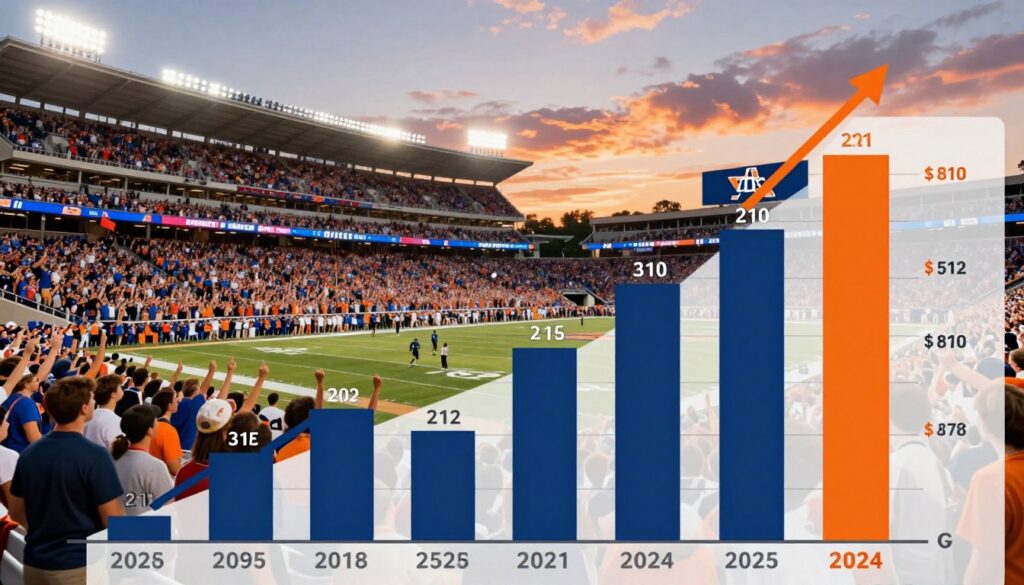
Let’s look at the raw college stadium stats. The growth shows Florida’s growing confidence:
| Year | Official Capacity | The Expansion Story |
|---|---|---|
| 1930 | 21,769 | The original concrete bowl opens. Built on a swamp, literally and financially. |
| 1950 | 40,116 | Post-war boom doubles the size. Florida football enters the big time. |
| 1966 | 62,800 | Upper decks begin their creep skyward. The arms race is on. |
| 1982 | 72,000 | More steel, more concrete. The stadium’s footprint becomes a campus landmark. |
| 1991 | 83,000 | The north endzone closes the bowl. The intimidating “Swamp” effect is complete. |
| Present | 88,548 | Current configuration. Largest in Florida, 12th largest in the U.S. |
Record attendance is where the magic happens. On November 28, 2015, 90,916 people filled The Swamp. It was a record-breaking event. The noise was so loud, it felt like an earthquake.
This growth shows how important The Swamp is. It’s ranked #12 nationally. It’s not just a place to watch games; it’s a key asset. Empty seats are a big deal in college sports. Every seat adds to the excitement and the team’s image.
The initial $118,000 investment seems small now. Today, we’re talking about $400 million renovations. It shows how much value is placed on creating an amazing experience. The stadium’s growth is like Florida’s own rapid development.
When you look at these college stadium stats, you see more than just numbers. You see a blueprint for success. Each expansion asked one question: How many people can we make uncomfortable to win? The answer is always “more.”
Legendary Moments
Steve Spurrier named the stadium “The Swamp” in 1992. It wasn’t just marketing; it was creating a myth. He turned a place into a living, breathing entity where “only Gators get out alive.”
The proof is in the bronze statues of three Heisman winners. They stand outside the gates. Their statues are not just decorations but the foundation of a religion. Wuerffel’s passes seemed divine, and Tebow’s promises were carved in stone.
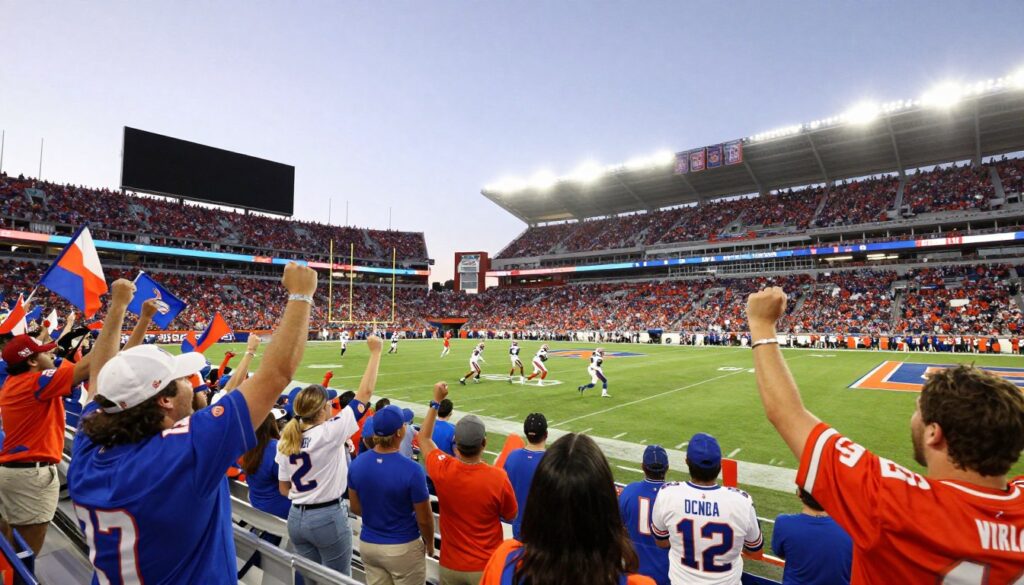
Now, let’s compare this to the NFL florida. The Swamp’s soul was built by a coach’s wit and player legacy. Its identity spans decades, not just fiscal quarters.
Drive north to Jacksonville or south to Miami. The story changes. The name on the stadium often reflects the biggest check. We’ve seen names like Joe Robbie and Dolphins. Even the historic Miami Orange Bowl fell victim to modern economics.
So, what makes a venue legendary? In college football, it’s tradition and triumph. In NFL florida, it’s often a branding deal. Both are uniquely Floridian. One builds ghosts for fans, the other luxury boxes for sponsors.
The table below captures the divide in how Florida’s football cathedrals build their souls:
| Aspect | College Identity (The Swamp) | NFL Florida Venues |
|---|---|---|
| Identity Source | Coach’s Analogy & Player Legacy | Corporate Sponsorship & Naming Rights |
| Time Horizon | Generational (Decades) | Contractual (5-10 Years) |
| Cultural Anchor | Heisman Statues, Fan Chants | Super Bowl Hostings, Renovation Cycles |
| Commercial Pressure | Moderate (Boosters, TV Deals) | Extreme (PSLs, Luxury Suites, Sponsors) |
| Fan Perception | “Our House” / Sacred Ground | “The Bank’s Stadium” / Multi-Purpose Venue |
The roar in The Swamp is for a legacy. The cheer in an NFL florida stadium is for a product. One isn’t necessarily better. But understanding the difference explains why some stadiums feel like home, and others feel like a very expensive hotel lobby.
Analytics on Home-Field Advantage
What makes this place so special? The design is a masterclass in creating an advantage. The stadium’s layout traps sound, making it hard for visitors to be heard. The noise level is a whopping 115 decibels.
The home team gets to enjoy shade, while visitors suffer in the Florida heat. It’s not just a game; it’s a battle against the elements.
From 1990 to 2010, Florida’s home record was an impressive 113-13. Steve Spurrier was almost unbeatable at The Swamp. EA Sports ranks Ben Hill Griffin as one of the toughest places to play. The numbers show it’s not just nostalgia; it’s science.
Fan loyalty is key. A sellout streak from 1979 to 2011 made the noise level almost unbeatable. The stadium even inspired the creation of Gatorade. Coaches like Gus Malzahn have praised the incredible noise.
The Swamp is more than a field. It’s a place where every element is used to gain an advantage. Visitors face not just the Gators but the environment itself. This is the secret to one of America’s most historic football stadiums.