

The Miami Dolphins’ defensive reset is not only about a new coach, a new general manager, or one first-round rookie. It is about a roster-building choice that now sits directly on the boundary between patience and pressure. Miami moved away from veteran cornerback Rasul Douglas after the 2025 season, used a first-round pick on San Diego State cornerback Chris Johnson, and entered July 2026 with a cornerback room built more on projection than proven stability.
That is why the Dolphins’ youth movement at cornerback could define the first season of the Jeff Hafley and Jon-Eric Sullivan era. Miami can talk about scheme, energy, and long-term flexibility, but the secondary will be where the rebuild becomes visible every Sunday. If the young corners hold up, the Dolphins can play faster, disguise more, and give their pass rush a cleaner runway. If they do not, the defense may spend 2026 trying to survive one matchup problem after another.
Why Cornerback Became The Test Case For Miami’s Reset
The Dolphins did not stumble into a younger cornerback room. They made a clear roster decision. After one season in Miami, Rasul Douglas left for the Washington Commanders on a one-year deal reportedly worth up to $3.8 million. The Phinsider reported on July 6, 2026, that Miami made no offers to Douglas, even after he produced 62 combined tackles, two interceptions, two forced fumbles, two tackles for loss, and two quarterback hits in 2025.
That matters because Douglas was not merely a veteran name. He was the kind of corner who could steady a young room, handle difficult coverage calls, and give a new defensive staff a more predictable boundary option. Letting him walk says something about Miami’s priorities. The Dolphins appear to be choosing age curve, contract control, and development runway over the comfort of retaining a known veteran.
The choice fits the broader Florida football pattern of linking money, roster construction, and long-term planning. At the college level, the same kind of structural thinking appeared in Florida’s 2026 budget conversation, where revenue, staffing, and competitive planning shaped the direction of the program. That wider financial lens is part of why Florida Gators athletics budget analysis connects naturally with Miami’s NFL reset: resources are not just numbers; they are strategy.
For the Dolphins, cornerback is where that strategy becomes risky. Offensive tackle Kadyn Proctor and cornerback Chris Johnson gave Miami two first-round anchors in the 2026 NFL Draft, but corner is less forgiving than most positions. A rookie lineman can receive help from scheme, chips, and protection calls. A rookie corner can be isolated in space against veteran receivers who identify weakness quickly.
Chris Johnson Is More Than A Draft Pick
Johnson is the centerpiece of the Dolphins’ youth movement because Miami did not passively wait for him. The Dolphins traded up from No. 30 to No. 27 in the 2026 NFL Draft to select him, sending No. 30 and No. 90 to the San Francisco 49ers for No. 27 and No. 138, according to the team’s first-round draft recap. That kind of move is not made for depth. It is made for a player the front office believes can change the depth chart.
Miami’s own draft profile described why Johnson made sense. He spent four seasons at San Diego State, appeared in 47 games, started his final 23, and finished his college career with 152 tackles, one sack, six interceptions, 20 passes defended, and five forced fumbles. In 2025, he was a second-team All-American, a first-team All-Mountain West selection, co-Mountain West Defensive Player of the Year, and a semifinalist for the Jim Thorpe Award.
Those details matter because Johnson’s profile is not built on one combine sprint or one viral interception. He played a lot, produced across multiple categories, and arrived with a defensive-back résumé that suggests he can handle responsibility early. General manager Jon-Eric Sullivan called him a big, physical corner with ball skills who can play outside or nickel, according to Miami’s draft-night comments.
That versatility could be central to Hafley’s defensive plan. A rookie corner who can only survive on one side limits the call sheet. A rookie who can move between outside and slot alignments gives the staff a better chance to protect matchups without giving away coverage intentions.
Why Hafley’s Scheme Raises The Stakes
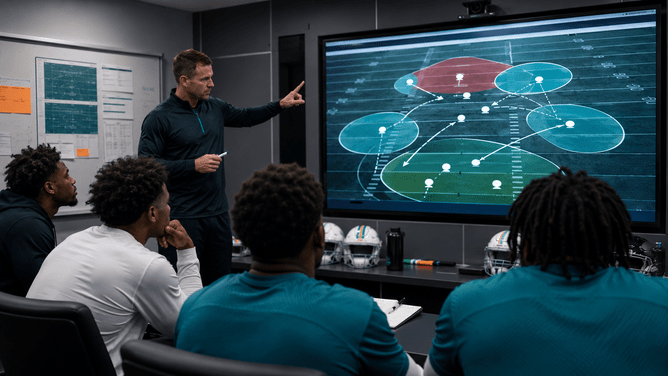
Jeff Hafley’s arrival gives the Dolphins a defensive-minded head coach with a background that should place real emphasis on coverage communication. Hafley spent 2024 and 2025 as the Green Bay Packers’ defensive coordinator before Miami hired him as head coach in January 2026. That résumé matters less as a headline and more as a clue: his first Dolphins defense will likely be judged by whether it creates structure for young players rather than chaos around them.
Young cornerbacks need that structure. The NFL is full of talented defensive backs who lose early because their eyes are late, their leverage is wrong, or the safety rotation behind them is not clean. Miami’s youth movement cannot succeed only because Johnson has athletic traits. It needs rules, repetition, and coverage answers that keep inexperienced corners from carrying impossible assignments.
Hafley has already praised Johnson’s transition. The Phinsider reported in June that Hafley described Johnson as instinctual, athletic, mature, and able to get his hands on the football during offseason work. That is encouraging, but summer praise is still only a starting point. Training camp, preseason work, and September game plans will determine whether Johnson can turn those traits into reliable snaps.
Miami’s official roster shows the cornerback room around him includes players such as Alex Austin, Darrell Baker Jr., Miles Battle, Ethan Bonner, JuJu Brents, Storm Duck, A.J. Green III, Jason Marshall Jr., Marco Wilson, and Johnson. That group has length, athletic variety, and competition. It also lacks the kind of obvious veteran No. 1 corner who removes doubt before camp begins.
The Depth Chart Battle Is Bigger Than One Rookie
Johnson may be the headline, but the Dolphins’ reset at cornerback will depend on how the rest of the room sorts itself out. Miami has several corners with traits that can fit specific roles. JuJu Brents brings size at 6-foot-3 and 198 pounds. Jason Marshall Jr., a former Florida Gator, gives the room a young in-state development piece. Marco Wilson brings more NFL experience than many of the younger options. Storm Duck, Alex Austin, and others add competition for depth and special-teams value.
That depth chart can work if roles become clear quickly. The danger comes if Miami reaches late August still unsure who should handle outside snaps, who fits best inside, and who can be trusted in high-leverage third-down situations. A cornerback room with options is useful. A cornerback room with unresolved answers can become a weekly target.
The Dolphins also need the cornerback group to match the rest of the defensive rebuild. A young pass rush led by players such as Chop Robinson needs coverage to hold long enough for pressure to arrive. Interior defenders such as Jordan Phillips and Kenneth Grant need the secondary to punish hurried throws. Safeties need corners who communicate leverage and do not force emergency help on every vertical route.
That is where the cornerback becomes more than a position group. It becomes the link between Miami’s front and back end. If the corners can play with discipline, Hafley can build pressure packages with confidence. If they are constantly stressed, the defense shrinks.
What Miami Gains By Going Younger
There is a clear upside to Miami’s youth movement. Younger corners give the Dolphins cost control, athletic upside, and a chance to build a secondary that grows with the new staff. If Johnson becomes a long-term starter and one or two other young corners develop into reliable contributors, the Dolphins can use future resources elsewhere instead of chasing expensive veteran fixes.
The financial angle is real. Veteran cornerbacks can become costly fast, especially when teams are trying to stabilize a defense quickly. Miami’s reported lack of interest in re-signing Douglas suggests the front office did not want to pay for a short-term bridge at the expense of evaluating younger players. That choice may look smart if Johnson and the rest of the group mature quickly.
The football upside is just as important. Young corners can give a defensive coach flexibility if they are coachable and athletic enough to handle multiple techniques. Press coverage, off-man looks, match-zone rules, and nickel movement all become easier when the staff trusts players to process fast. Johnson’s college résumé and testing profile suggest Miami believes he can do that.
There is also a cultural angle. Hafley and Sullivan are not inheriting a finished contender. They are trying to define what the next Dolphins core should look like. A young cornerback room gives them a chance to build habits rather than manage exceptions. That does not guarantee better results in 2026, but it could give Miami a cleaner foundation for 2027 and beyond.
Where The Risk Could Show Up First
The risk will likely show up against teams that can force Miami into matchup decisions. Spread formations, motion-heavy passing games, and veteran quarterbacks will test whether the Dolphins’ corners understand leverage and route distribution. Opponents do not need to attack Johnson every play. They only need to find the weakest communication point.
Rookie corners often face three problems early. They grab when they are late. They overreact to double moves. They lose patience when quarterbacks extend plays. Johnson’s ball skills and athleticism can help, but every young corner has to learn that NFL receivers win with tempo, spacing, and route detail as much as speed.
The other risk is tackling. Miami’s cornerback group cannot become a pass-only unit. AFC offenses will test edges with screens, outside runs, and quick throws designed to make corners tackle in space. Douglas gave Miami size and veteran tackling production in 2025. Replacing that is not just about interceptions. It is about avoiding cheap yards after the catch.
That is why 2026 should not be measured only by Johnson’s interception total. A strong rookie year may look like fewer explosive mistakes, steady tackling, smart penalties, and enough pass breakups to make quarterbacks hesitate. If he reaches that baseline, Miami can live with the growing pains.
What Would Make The Youth Movement A Success
A successful 2026 season for Miami’s cornerbacks does not require the Dolphins to produce an elite pass defense overnight. The realistic goal is to leave the season knowing which young defensive backs are part of the next core. That means Johnson proves he can start. One of the other young corners claims a consistent role. The staff identifies a reliable nickel plan. The defense avoids weekly breakdowns that force conservative play-calling.
A more optimistic version would be Johnson becoming Miami’s best corner by midseason, Brents or Marshall giving the team a second long-term option, and Wilson or another veteran piece providing enough stability to keep the room balanced. That would turn a risky offseason bet into a clear development win.
The Dolphins’ offense may draw more national attention, but the cornerback room could determine the tone of Hafley’s first year. Young defenses can survive mistakes when those mistakes are aggressive, correctable, and tied to development. They struggle when the same coverage errors repeat and force the staff to simplify.
Miami’s youth movement at cornerback is not a side story. It is the pressure point of the reset. The Dolphins chose not to bring back their most productive 2025 veteran at the position, invested a first-round pick in Johnson, and opened the door for several young defensive backs to shape the future of the secondary. If that bet works, 2026 becomes the year Miami found the foundation of its next defense. If it fails, the rebuild will feel much longer than one season.