

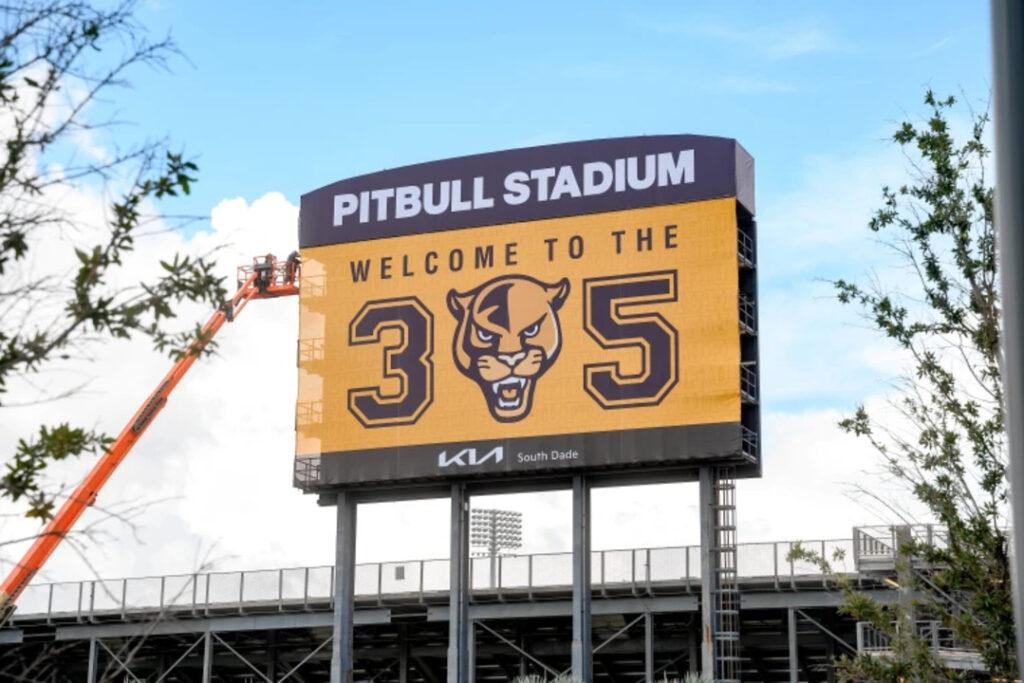
When I look at the evolving landscape of college football in 2026, it’s clear that winning games is no longer the only path to relevance. Programs are now competing just as aggressively off the field through branding, partnerships, and visibility. Few examples capture this shift better than the FIU Panthers Pitbull Stadium deal, a partnership that has sparked debate while simultaneously placing Florida International University firmly in the national conversation.
At first glance, it might seem unusual for a program not dominating headlines on the scoreboard to remain this visible. But as I’ve followed the story, it becomes obvious that FIU is tapping into something larger: the growing intersection of sports, entertainment, and marketing.
The Deal That Put FIU in the Spotlight
The FIU Panthers Pitbull Stadium agreement centers around a naming-rights partnership with global music artist Pitbull, who has deep ties to Miami. The collaboration is designed to merge sports with entertainment, leveraging Pitbull’s brand to elevate FIU’s visibility both locally and nationally.
From a strategic standpoint, the move is bold. Naming rights deals are nothing new in professional sports, but in college football especially at the Group of Five level they are still relatively uncommon in this form. FIU’s decision signals a willingness to experiment in a space where many programs remain conservative.
The result has been immediate attention. Whether praised as innovative or criticized as unconventional, the deal has ensured that FIU is part of the broader college football conversation.

Why the Partnership Has Sparked Debate
Not every reaction to the FIU Panthers Pitbull Stadium deal has been positive. Critics have questioned whether aligning so closely with a celebrity brand risks overshadowing the university’s identity. Others have raised concerns about the long-term sustainability of such partnerships, particularly if on-field success does not follow.
From my perspective, the criticism reflects a deeper tension within college athletics. There is a traditional view that programs should build relevance through performance, history, and alumni support. But the modern reality is more complex. With the rise of NIL (Name, Image, Likeness) deals and increased commercialization, branding has become an essential part of staying competitive.
FIU’s approach challenges the idea that smaller programs must wait for success to gain recognition. Instead, it suggests that visibility itself can be a starting point.
The Business of College Football Is Changing
To understand why the FIU Panthers Pitbull Stadium deal matters, it helps to look at the broader context. College football is no longer just a sport it is a multi-billion-dollar ecosystem where media exposure, sponsorships, and fan engagement play critical roles.
Major programs in the SEC and Big Ten have long benefited from television deals and national exposure. For smaller programs like FIU, breaking into that spotlight is significantly more difficult. That’s where creative partnerships come into play.
By aligning with a globally recognized artist like Pitbull, FIU is effectively borrowing reach. The partnership extends beyond the stadium name; it creates opportunities for cross-promotion, events, and media coverage that might otherwise be out of reach.
For readers interested in how college athletics is evolving, the NCAA provides an overview of how programs are adapting to modern financial and branding challenges. You can explore more about FIU Panthers Pitbull Stadium within the broader context of college football’s changing structure.
On-Field Performance vs Off-Field Visibility
One of the most interesting aspects of this story is the contrast between FIU’s on-field results and its off-field presence. The Panthers have not been a dominant force in recent seasons, yet they continue to generate discussion because of their branding strategy.
This raises an important question: Can marketing compensate for performance?
In my view, the answer is nuanced. Branding alone cannot replace winning games. Success on the field still drives long-term fan loyalty, recruiting, and program prestige. However, visibility can create opportunities that make success more achievable.
For example, increased exposure can:
- Attract recruits who want to play in a more visible program
- Generate additional revenue streams
- Strengthen partnerships with sponsors and media outlets
In that sense, the FIU Panthers Pitbull Stadium deal is less about replacing performance and more about building a platform that could support future growth.
A Strategic Gamble or a Smart Move?
Every innovative strategy carries risk, and FIU’s approach is no exception. The success of the FIU Panthers Pitbull Stadium partnership will ultimately depend on how well it translates into tangible benefits for the program.
To better understand the potential impact, consider this breakdown:
| Factor | Potential Benefit | Risk |
|---|---|---|
| Branding | Increased national recognition | Overshadowing school identity |
| Revenue | New sponsorship opportunities | Dependence on external partnerships |
| Recruiting | Greater exposure for athletes | Limited impact without winning |
| Fan Engagement | Broader audience reach | Mixed reception from traditional fans |
What stands out to me is that FIU is willing to take a calculated risk in a space where standing still often means falling behind. In today’s college football environment, that willingness to innovate may be just as important as any single game result.
Why This Matters Beyond FIU
The implications of the FIU Panthers Pitbull Stadium deal extend beyond one program. It represents a broader shift in how college teams approach relevance. As media landscapes evolve and attention becomes more fragmented, programs must find new ways to stand out.
FIU’s strategy could serve as a blueprint or a cautionary tale for other schools. If successful, it may encourage more universities to explore unconventional partnerships. If it falls short, it will reinforce the importance of traditional paths to success.
Either way, it highlights a key reality: college football is no longer just about what happens on Saturdays.
Conclusion
The story of the FIU Panthers Pitbull Stadium deal is ultimately about adaptation. In a rapidly changing sports landscape, FIU has chosen to embrace innovation rather than wait for results to drive attention. The partnership has generated debate, sparked interest, and positioned the program in a way that few would have predicted.
From where I stand, the most important takeaway is not whether the deal is perfect, but what it represents. It shows that relevance in college football can now be shaped by more than wins and losses. Branding, partnerships, and visibility are becoming equally important pieces of the puzzle.
The real test will come in the years ahead. If FIU can translate this attention into on-field progress, the strategy will look visionary. If not, it may be remembered as an ambitious experiment. Either way, the FIU Panthers Pitbull Stadium partnership has already achieved something significant it has made people pay attention.