

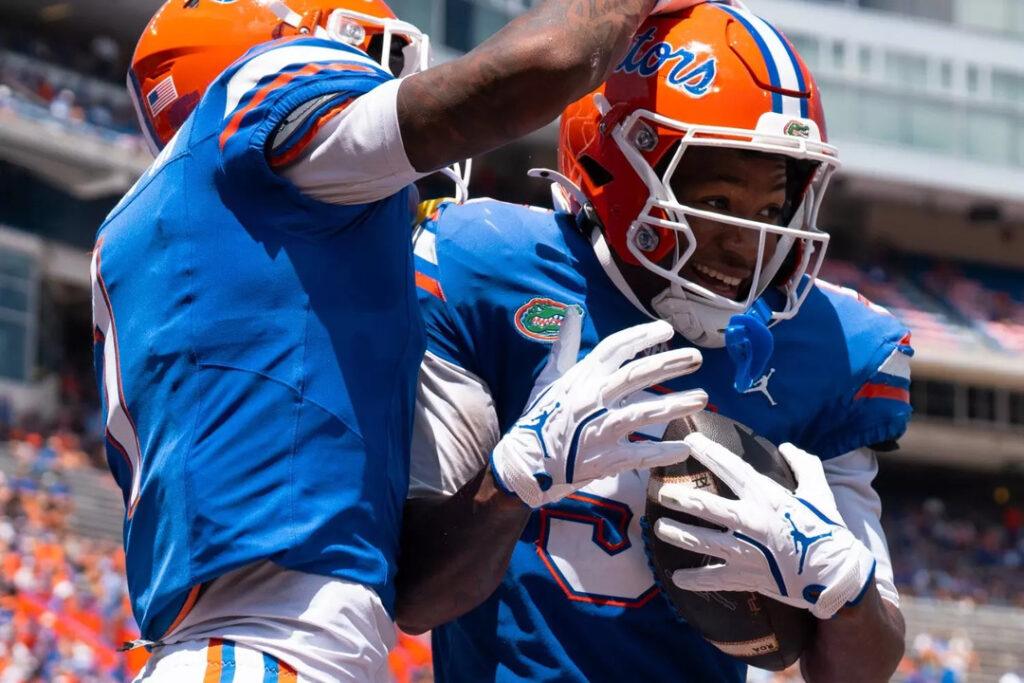
The spring game did more than entertain; it clarified where Florida’s offense may be headed next. I came away from the Orange & Blue showcase convinced that the most important development was not simply a few big plays, but the emerging shape of an offense that suddenly looks faster, more dangerous, and far more difficult to defend.
In a single afternoon, Florida’s revamped receiver room gave the clearest indication yet that the program may have found its quickest path back to offensive relevance. The most striking numbers belonged to Micah Mays Jr. and Eric Singleton Jr., who combined for 10 catches, 214 yards, and three touchdowns. Those are spring-game statistics, yes, but they also felt like a preview.
A Spring Game That Revealed More Than It Hid
Spring games are often noisy evaluations. Coaches protect parts of the playbook, quarterbacks work under unusual constraints, and defensive structure can be uneven. Even so, some performances cut through the usual caution, and this one did.
What stood out to me was not only the production itself, but the manner in which it arrived. Florida’s most explosive moments came through receivers capable of winning in different ways. There was speed, certainly, but there was also route acceleration, spatial awareness, and the kind of late separation that makes quarterbacks look more comfortable and coordinators more ambitious.
That matters because offensive identity is rarely built from abstract philosophy alone. It is built from personnel that forces a coaching staff to lean into what works. Florida now appears to have a receiver group capable of changing the geometry of the field. That changes everything else, from quarterback confidence to defensive leverage to how often a coordinator feels free to call aggressively on early downs.
For readers tracking the broader evolution of the sport, the modern Florida Gators transfer receivers story fits directly into the larger trend of roster acceleration in college football. Elite receiver play can shift an offense faster than almost any other position group, particularly when a team is trying to become more explosive without waiting multiple recruiting cycles to get there.
Why The Receiver Room Suddenly Feels Different
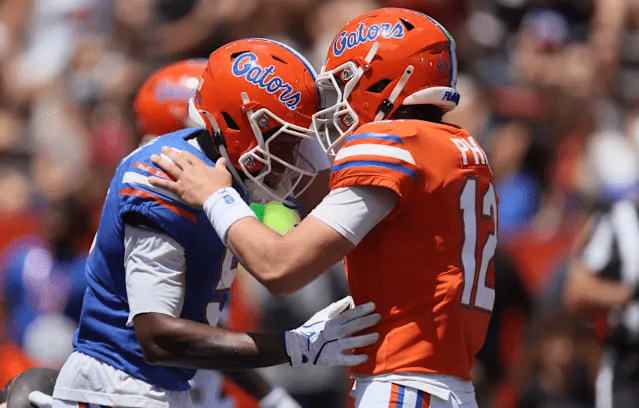
The raw total from Mays and Singleton is impressive, but the more important takeaway is that Florida’s receiver room no longer appears dependent on one singular style of playmaker. I see a unit beginning to offer multiple answers.
Mays flashed the downfield dimension that defensive coordinators fear most. A receiver who can sell an intermediate concept and then turn it into a vertical strike does more than generate highlights; he changes coverage behavior. Safeties hesitate. Corners lose the freedom to squat on routes. Defensive calls grow more conservative, even when the offense is not actively hunting a shot play.
Singleton’s impact felt slightly different, and equally important. His presence suggested a receiver who can stress defenses in space, create separation quickly, and turn routine throws into meaningful gains. That kind of threat is essential in contemporary college football, where offenses increasingly live on tempo, spacing, and the ability to punish missed angles after the catch.
Together, their production offered a compelling early blueprint for what Florida might become. This receiver room looks built not merely to catch passes, but to alter defensive structure before the ball is even snapped.
What This Means For Florida’s Quarterbacks
No position benefits more immediately from improved receiver play than quarterback. I do not think that point can be overstated.
A talented receiver corps widens the margin for error. Throws do not have to be perfect when targets can separate late, adjust naturally, and finish through contact. Timing becomes easier to trust. Reads feel cleaner. The offense can ask more from the quarterback because the surrounding environment becomes more forgiving.
That is especially relevant in spring, when quarterback development is often judged too harshly in isolation. If the perimeter talent improves, decision-making tends to speed up naturally because windows become more obvious. The result is not just better production on paper but a more assertive offense overall.
In Florida’s case, I see the possibility of a passing game that can support multiple quarterback strengths rather than requiring one narrow profile. A vertical thrower can benefit from the field-stretching speed. A rhythm passer can thrive on timing routes and yards-after-catch opportunities. A young quarterback can rely on athletes who create separation quickly enough to simplify reads.
That versatility is not a luxury. It is strategic insulation.
The Offensive Ceiling Is Rising
The clearest implication of Florida’s spring performance is that the offense may be capable of creating explosive plays at a much higher rate. For a team trying to reestablish itself in a brutally competitive conference, that is not a cosmetic improvement. It is foundational.
Explosive offenses do three things exceptionally well: they punish single coverage, they convert ordinary field position into scoring threats, and they force opponents into uncomfortable risk calculations. Florida’s transfer receivers hinted at all three.
Here is a concise look at why that matters:
| Area | What The Spring Game Suggested | Why It Matters |
|---|---|---|
| Vertical Threat | Florida can win deep with speed and route deception | Safeties must play with more caution |
| Short-To-Intermediate Game | Receivers can create separation and run after the catch | Easier completions become bigger gains |
| Quarterback Support | Targets appear more forgiving and versatile | Offensive consistency improves |
| Play-Calling Flexibility | Multiple receiver skill sets expand the menu | The offense becomes harder to predict |
What I find most important is that Florida’s offensive upside now appears more layered. A dangerous offense is not one that only throws deep or only lives on spacing concepts. It is one that can move seamlessly between pressure points, attacking leverage wherever the defense is weakest.
That is the kind of unit Florida may be trying to build.
Why Transfer Receivers Are Often The Fastest Fix
In modern college football, receiver has become one of the quickest positions to upgrade through transfers. The learning curve is real, but the impact can be immediate when the traits translate. Speed translates. Ball tracking translates. Space creation translates. Competitive confidence certainly translates.
Florida’s spring game reinforced that reality. Rather than waiting for an offense to slowly evolve through developmental recruiting alone, the program appears to be using experienced skill talent to compress the timeline. I think that is one of the central competitive truths of this era: programs no longer need to wait patiently when an urgent weakness can be addressed through the portal.
That does not mean every transfer-heavy approach works. Chemistry still matters. Timing still matters. Receiver rooms still need hierarchy, trust, and clarity of role. But when it clicks, the effect is immediate and visible. Florida’s showcase suggested that the process may already be moving in that direction.
The most important signs were these:
- Florida’s perimeter speed looked noticeably more dangerous
- The passing game appeared capable of generating chunk plays quickly
- The offense showed the outlines of a more flexible identity
- Multiple receivers looked capable of becoming real weekly factors
Those are not final judgments. They are early indicators. Still, in spring football, early indicators are often the most revealing signals we get.
The Real Test Comes Next
I would be cautious about overselling any April scrimmage. Spring football can exaggerate both optimism and concern. Defenses are installing. Rotations are experimental. The full competitive environment of the regular season is absent.
But I would be equally cautious about dismissing what Florida showed.
Receiver-driven transformation is one of the most believable forms of offseason change because it is so visible. When the speed is different, everyone in the stadium sees it. When the burst is real, it changes how defenders react. When two newcomers combine for 214 yards and three touchdowns, that is not statistical wallpaper. It is an announcement.
The bigger question now is whether Florida can sustain that spark across a full offense. Can the quarterbacks consistently capitalize on it? Can protection hold up long enough to unlock the vertical game? Can the scheme blend downfield aggression with the efficient underneath work that keeps drives alive? Those are the questions that will determine whether spring promise becomes autumn production.
Still, the evidence from this performance points in one direction: Florida may have found its offensive accelerant.
Why This Matters Right Now
This matters now because spring is when programs reveal what they want to become, even if they do not yet fully resemble it. Florida’s message was unmistakable. The transfer receivers were not just productive; they looked like the most convincing pathway to a more explosive, more modern, and more dangerous offense.
I do not think that is a minor spring storyline. I think it may be the defining offensive development of Florida’s offseason.
If that receiver room continues to grow into its early promise, Florida will not simply be counting on incremental improvement in 2026. It will be betting on a genuine shift in offensive identity, one built on speed, stress, and the ability to flip a game with a single throw. Right now, that feels less like hope and more like a plan.