

Florida college football is not waiting for opening weekend to become interesting. Across the state, the 2026 season is already taking shape as a quiet power reset, with USF preparing for its final year at Raymond James Stadium, Florida trying to reframe its SEC identity, Florida State working the recruiting runway, Miami adjusting its ACC calendar, and UCF trying to prove its Big 12 reset has real traction.
The story is not just that Florida has a lot of college football programs. The story is that many of them are entering 2026 with something specific to prove, and the pressure is coming from different directions.
Florida College Football Has More Moving Parts Than One Headline Can Hold
A statewide football reset does not always arrive with one massive breaking-news moment. Sometimes it shows up in smaller signals: a stadium project becoming more visible, a schedule release giving shape to expectations, a rivalry game getting a national window, or a recruiting move that hints at how a program wants to build its next roster.
That is what makes the 2026 picture in Florida so intriguing. The Gators, Seminoles, Hurricanes, Knights, Bulls, Owls, and Panthers are not chasing the same version of success. Some are trying to win back belief. Some are trying to build a stronger local identity. Some are trying to make conference membership feel like opportunity instead of pressure.
USF may be the cleanest example. The Bulls are not simply entering another season; they are playing the final stretch before a major campus-stadium era. Florida, meanwhile, is trying to turn offseason structure into on-field credibility. UCF has a different problem: it has to look like a program moving forward in the Big 12, not just a program proud to be there.
That variety gives the state its real tension. Florida football is no longer just about which brand is biggest. It is about which program can make its next step feel believable first.
USF’s Stadium Countdown Gives the Bulls a Rare Moment
USF has one of the strongest under-the-radar stories in the state because its 2026 season carries a built-in before-and-after feel. The Bulls are preparing for their final season at Raymond James Stadium before moving toward an on-campus future, and that changes how the year should be judged.
A final season in an NFL venue can be sentimental, but USF needs it to be more than ceremonial. The Bulls need visible fan energy, a strong home atmosphere, and a football product that makes the next era feel earned. A campus stadium can help reshape a program’s identity, but it cannot create credibility by itself.
The school’s on-campus stadium and football operations update gives fans a clearer look at how serious the next phase is becoming. The bigger question is whether the team can match that ambition before the new venue opens.
That is where Brian Hartline’s first season becomes so fascinating. His reputation gives USF immediate attention, especially in recruiting conversations, but attention is not the same as proof. The Bulls need signs of organization, discipline, and identity. If those arrive quickly, USF could become the Florida program that casual fans start checking on more often.
Florida and Florida State Are Fighting Different Battles
Florida and Florida State still carry the most familiar statewide rivalry tension, but their 2026 pressure points are not identical.
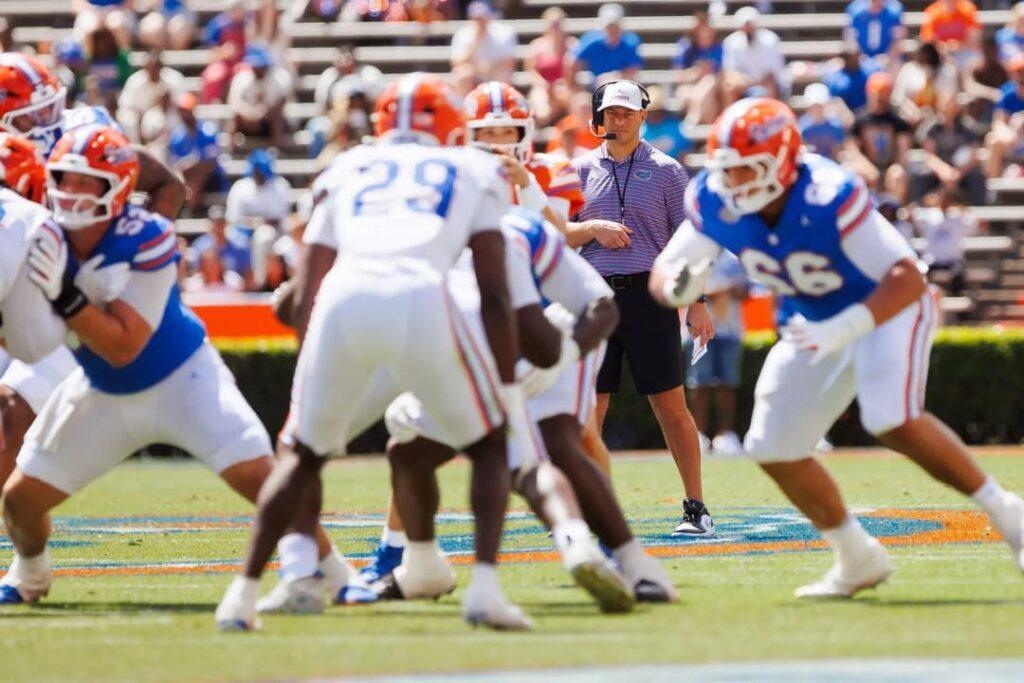
For Florida, the issue is immediate credibility. The Gators’ home schedule and fan-facing game designations give the program multiple chances to create a more energetic version of The Swamp experience. Florida’s 2026 home game designations also show how much the program is leaning into event-building around the season, not just the games themselves.
That matters because Florida cannot afford to feel ordinary at home. The SEC is too demanding, the fan base is too impatient, and the brand is too visible. A program can talk about rebuilding, but the home environment has to make that rebuild feel alive.
Florida State’s pressure is more layered. The Seminoles have a rivalry game against Florida on a national stage, but they also have to keep stacking roster signals beyond the current season. Quarterback recruiting is one of the cleanest places to read those signals, and the conversation around Florida State’s 2027 QB room signal matters because it points toward how the Seminoles want to stabilize the future, not just survive the present.
The Florida-FSU rivalry will always matter. In 2026, though, it may become a referendum on which program looks more convincing in its direction.
Miami and UCF Are Both Trying to Control the Narrative
Miami’s 2026 story is less about one dramatic offseason move and more about structure. A schedule adjustment can seem minor on the surface, but in college football, timing shapes perception. Late-season ACC games carry more weight when a team is still in contention, and Miami needs its home games to feel like meaningful checkpoints rather than isolated events.
The Hurricanes have the brand, recruiting footprint, and market presence to command attention. What they need is a season that turns those advantages into week-to-week trust. Miami has spent too many years being discussed as a program with potential. At some point, potential has to stop being the lead paragraph.
UCF faces a different version of the same problem. The Knights are no longer the ambitious outsider trying to crash a bigger room. They are in the Big 12, and that means the evaluation has changed. Close losses, roster churn, and transitional language do not carry the same weight forever.
Scott Frost’s return gives UCF a familiar figure and a clear emotional hook, but the next step has to be performance. The Knights need to make their conference schedule feel like a platform, not a weekly reminder of how difficult the move upward can be. That is the schedule pressure sitting underneath UCF’s season.
The State’s Smaller Programs Could Shape the Bigger Conversation
FAU and FIU may not control the statewide spotlight, but they still matter in the 2026 Florida football picture. Their relevance comes from geography, scheduling, and opportunity.
FAU has in-state games that can keep the Owls connected to the broader Florida conversation. FIU has a chance to build local energy through a schedule that keeps the Panthers visible inside the state. These programs are not competing with Florida or Florida State for the same kind of national attention, but they are competing for relevance in a crowded football market.
That matters more than it may seem. In-state matchups help smaller programs create moments that travel beyond their usual audience. A strong showing against another Florida team can generate recruiting talking points, fan interest, and regional credibility.
Here is how the major Florida programs’ 2026 storylines compare:
| Program | Main 2026 Pressure Point | Why It Matters |
|---|---|---|
| USF | Final Raymond James season and stadium transition | The Bulls need momentum before their campus era begins |
| Florida | Home-field identity and SEC credibility | The Gators must make the rebuild feel real quickly |
| Florida State | Rivalry stage and future QB development | The Seminoles need both present confidence and future stability |
| Miami | ACC schedule positioning | The Hurricanes need a season that matches their brand power |
| UCF | Big 12 progress under Scott Frost | The Knights must show the reset is producing results |
| FAU | In-state relevance | The Owls can use Florida matchups to raise visibility |
| FIU | Local schedule opportunity | The Panthers can build momentum through regional games |
The table shows why this is not a one-team story. Florida’s college football map is crowded, but 2026 gives almost every program a distinct lane.
The Next Signals Will Come Before the First Big Upset
The first major clue will be atmosphere. USF’s final Raymond James season, Florida’s home schedule energy, Miami’s late-season ACC setup, and UCF’s Big 12 home games will all reveal whether fans are buying the story each program is selling.
The second clue will be quarterback direction. In modern college football, confidence at quarterback changes everything: recruiting tone, media perception, offensive identity, and fan patience. Florida State’s future quarterback movement, Florida’s offensive development, and UCF’s reset all connect back to that same position.
The third clue is whether the smaller programs can create noise. FAU and FIU do not need to dominate headlines all season, but they do need moments. A competitive in-state game can do more for perception than a routine win that nobody outside the fan base notices.
That is the next proof point for Florida as a football state. The programs do not need identical goals. They need convincing evidence that their current direction is more than offseason messaging.
Florida college football is entering 2026 with unusual depth, and that is what makes the season feel bigger before it begins. USF has a stadium transition that could redefine its identity, Florida and Florida State have pressure tied to credibility and direction, Miami has to turn structure into substance, and UCF has to prove its Big 12 reset is more than a familiar-name reboot. The state’s football map may not flip overnight, but the programs that use 2026 well could change how fans read Florida’s hierarchy for years.