

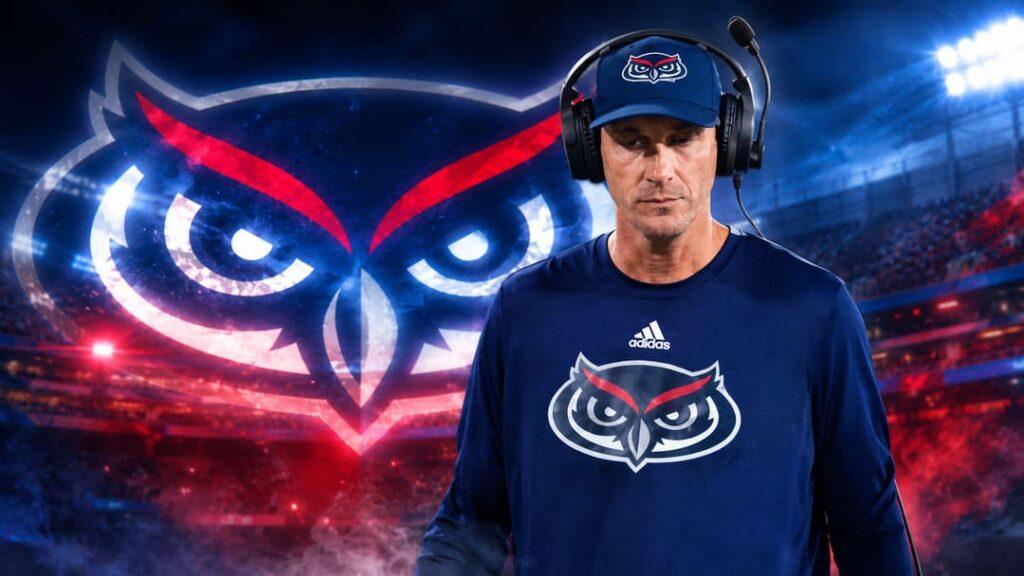
FAU football continuity is not the loudest offseason storyline in Florida, but it may be the most useful one in Boca Raton. Zach Kittley’s second year gives the Owls something rare in the transfer-portal age: a returning full-time staff, a returning starting quarterback, and enough shared language to turn last year’s installation into this year’s advantage.
That matters because FAU does not need another reset. It needs proof that the offense can sharpen, the staff can evaluate faster, and the roster can turn familiarity into wins before the American Athletic Conference race leaves the Owls behind.
FAU Football Continuity Is The Real 2026 Story
Most college football offseasons are built around arrivals. New coordinators, new quarterbacks, new transfers, new promises. FAU’s story is different because the Owls are leaning into stability at a time when stability has become almost countercultural.
The most important detail is simple: Florida Atlantic returns its entire full-time coaching staff and starting quarterback Caden Veltkamp for 2026. That combination gives the program a meaningful foundation after Kittley’s first season, especially for an offense that depends on timing, recognition, spacing, and quarterback comfort.
The official program language around FAU football continuity frames the Owls as unusually settled in a sport where staff turnover and roster churn often erase progress before it matures. That does not guarantee a breakthrough, but it gives FAU something many programs would take immediately: fewer unknowns.
I like this topic because it is not built on hype alone. Continuity is useful only when the pieces are worth keeping. In FAU’s case, the return of the staff and quarterback allows the program to spend less time explaining the basics and more time fixing the details.
Why Continuity Has Become Rare In College Football
The modern college football calendar is not gentle. The portal changes rosters quickly. NIL changes leverage. Coaching searches move faster. Players are asked to make career decisions under constant pressure. Staffs are rebuilt before systems settle.
That makes FAU’s position unusual. Returning a quarterback matters. Returning a staff matters. Returning both matters more because the relationship between play caller, position coaches, quarterback, and skill players is where offensive identity becomes functional.
The first year under a new offensive-minded coach often includes friction. Players learn terminology. Coaches learn what players can actually handle. Quarterbacks learn how aggressive they can be. Receivers learn spacing rules. Linemen learn tempo and protection demands. Mistakes are not always failures; sometimes they are the cost of building a shared language.
Year 2 should look different. The same route concepts arrive with more confidence. The same protection calls get made faster. The same practice periods become more efficient. The same coaches can correct players with more clarity because everyone understands the baseline.
That is the trade-off FAU is betting on. Instead of selling another new beginning, the Owls are selling development.
What Kittley Gains From A Second Year
Kittley arrived at FAU with a reputation as an offense-first coach, and that matters because his system is not meant to be passive. The Owl Raid concept asks a team to play with tempo, spacing, and aggression. Those ideas sound exciting, but they also demand execution.
A second year gives Kittley the chance to coach beyond installation. That is a major difference. Installation is about teaching what to do. Refinement is about teaching why, when, and how to adjust when the defense changes the picture.
That is where a returning staff becomes valuable. Coaches can evaluate spring and preseason practices through a sharper lens because they already know the roster’s strengths and limitations. They can spot bad habits earlier. They can identify which players understand the system and which ones only know the script.
For Kittley, the benefit is control. He can spend more time shaping game plans around proven personnel and less time discovering what he has. That is not glamorous, but it is often the difference between an offense that looks exciting in stretches and one that can survive four quarters.
The risk is that continuity can become comfort. FAU cannot assume returning the same people automatically creates a better team. The staff has to use the familiarity as a tool, not a blanket.
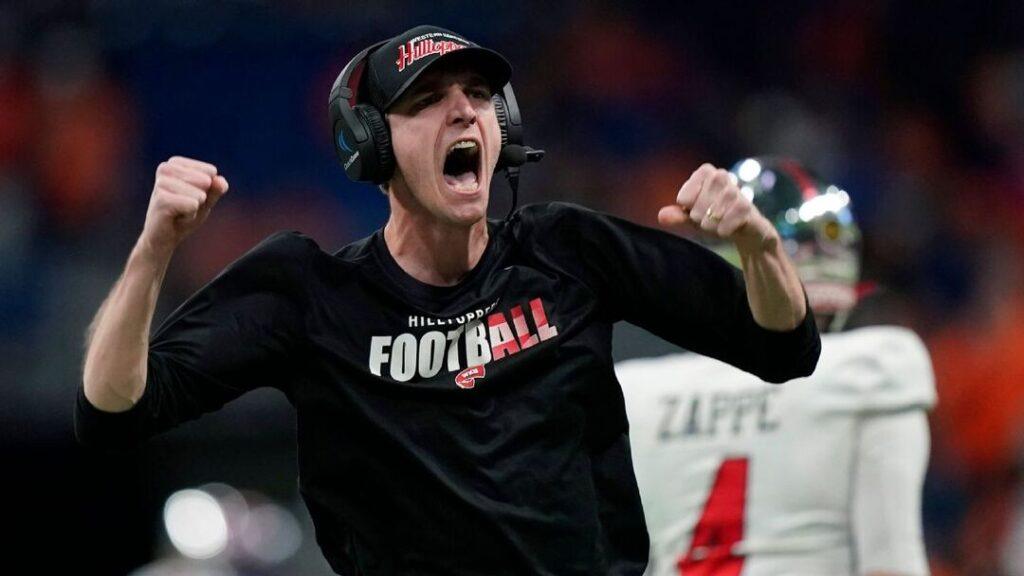
Caden Veltkamp Changes The Offensive Timeline
Quarterback continuity changes everything. When a new staff has to break in a new starting quarterback, the entire offense gets slower. Even talented quarterbacks need time to absorb checks, protections, route timing, pressure answers, and the rhythm of the coordinator.
Veltkamp’s return gives FAU a shorter runway. He already has experience in the system, and that experience should allow the offense to open camp at a more advanced stage. Instead of asking basic questions about command, the staff can focus on precision.
That does not mean the quarterback position is solved. Returning experience should raise expectations, not lower them. Veltkamp still has to become cleaner, faster, and more punishing when defenses make mistakes. The next step is not simply knowing the offense. It is mastering it well enough to create answers when the first read disappears.
This is the heart of the 2026 FAU offense. If Veltkamp turns continuity into better decisions, the Owls become more dangerous. If the offense remains streaky, the continuity story loses some of its weight.
The Staff Continuity Piece May Matter Even More
Quarterback return gets the headline, but the full-time staff return may be the deeper advantage. College football programs do not run only through the head coach. They run through position rooms, meeting habits, recruiting communication, strength plans, film language, and daily standards.
When staff members return together, the players hear fewer mixed messages. The offensive line coach does not have to reinterpret a new coordinator’s vocabulary. Receivers are not relearning route details from a different voice. Defensive players are not starting from scratch with new position expectations.
That cohesion should make practices cleaner. It should help young players learn faster. It should also make roster evaluation more honest because the staff has a full year of evidence, not just spring impressions.
This is especially important at a program like FAU, where development and fit can matter as much as raw recruiting ranking. The Owls need players who understand roles, improve physically, and buy into a system that may not offer the same margin for error as larger-budget programs.
Continuity creates accountability. If the same staff returns, excuses become thinner. The coaches know the players. The players know the coaches. The next step has to show up on the field.
Where The Continuity Advantage Can Show Up
FAU’s continuity should be visible in specific places. If it is not, the storyline becomes empty.
| Area | What Continuity Should Improve |
|---|---|
| Quarterback decisions | Faster reads, cleaner protections, fewer forced throws |
| Receiver timing | Better route spacing and stronger third-down rhythm |
| Offensive tempo | Less confusion before the snap and more control between plays |
| Staff communication | More consistent teaching across position rooms |
| Game management | Quicker adjustments because the staff knows the roster better |
The biggest potential gain is offensive rhythm. Air-raid-style systems can look brilliant when timing is sharp and frustrating when details are loose. A second season should reduce those loose moments.
Another area is situational football. Third down, red zone, two-minute offense, and late-game drives are where continuity often becomes value. Coaches can install more specific answers because they know what their quarterback likes. Players can react instead of thinking through every step.
That is the difference between familiarity and functional familiarity. FAU needs the second version.
Why This Is A Better Story Than A Normal Preview
A basic FAU preview would ask whether the Owls can improve in Year 2. That is fine, but it misses the stronger angle. The better question is whether continuity is now FAU’s biggest 2026 weapon.
That framing gives the story more context. It connects the Owls to the broader chaos of college football. It explains why returning staff and quarterback pieces are not boring details but competitive assets. It also creates a natural tension: if FAU has this much continuity, how much improvement should be expected?
That is what makes the topic useful for readers. It does not oversell the Owls as a sure breakout team. It asks a fairer question. What should a program do with rare continuity when the schedule, conference, and roster still demand more?
For a deeper look at where this season could go, Florida Atlantic’s 2026 competitive edge fits naturally into the bigger question of whether FAU can convert familiarity into results.
The Trade-Off: Continuity Also Removes Excuses
Continuity is a gift, but it is also a mirror. When a team has the same staff and quarterback, the pressure shifts from learning to producing. FAU cannot hide behind transition forever.
That is the uncomfortable side of this story. If the offense stalls, the staff cannot blame a brand-new system. If communication breaks down, the staff cannot blame unfamiliarity. If the quarterback play does not improve, the return of the starter becomes a question rather than an answer.
That does not mean FAU has to become perfect. It means the bar changes. The Owls should look more organized, more intentional, and more capable of responding when games get messy.
The same applies defensively. Even if the offensive continuity gets most of the attention, Year 2 should improve the whole program’s discipline. Special teams operation, substitutions, tackling angles, late-half decisions, and game-week preparation all reflect staff cohesion.
This is where Kittley’s staff has to prove the continuity is active. Keeping the same people is not enough. The work has to look sharper.
Recruiting Also Benefits From A Settled Staff
Continuity is not only a game-day issue. It is a recruiting tool.
Prospects and families pay attention to staff stability. They want to know who will coach them, what system they will enter, and whether the person recruiting them will still be there when they arrive. FAU can offer more confidence in those conversations than programs going through staff turnover.
That matters in Florida, where recruiting competition is relentless. The Owls are not recruiting in a quiet market. They compete for attention against major brands, rising Group of Five programs, in-state rivals, and national staffs that recruit South Florida heavily.
A stable staff helps FAU sell trust. It also allows coaches to build longer relationships without constantly restarting. Over time, that can improve roster fit, especially if the staff identifies players who match Kittley’s offensive style and the program’s developmental needs.
The FAU continuity push also matters internally because returning players can tell recruits what the program feels like, not just what coaches promise. That player-to-player credibility can carry real influence.
What Readers Should Watch During The Season
The first watch point is offensive efficiency. FAU does not need to prove it can be interesting. It needs to prove it can be consistent. Explosive plays are valuable, but empty drives and careless mistakes can erase them quickly.
Second, watch Veltkamp’s command. Does he look faster before the snap? Does he protect the ball better? Does he punish blitzes? Does he keep the offense calm after negative plays? Those are the signs of quarterback maturity.
Third, watch the staff’s adjustment pattern. Continuity should make halftime and in-game corrections cleaner. If the same issues repeat every week, the staff continuity advantage becomes harder to defend.
Fourth, watch physical response. FAU’s offensive identity cannot only live in space. The Owls must handle pressure, protect the quarterback, and survive when opponents force them into tougher downs. That will test their resilience.
Finally, watch whether the roster looks connected. Teams with real continuity usually show it in body language, substitution rhythm, and situational awareness. The best version of FAU should look less rushed and more certain about who it wants to be.
The Opportunity In Boca Raton Is Real
Florida Atlantic is not trying to win a press conference anymore. It is trying to build a football product that feels sustainable. That is why 2026 matters.
Kittley’s first year introduced the plan. The second year has to reveal whether the plan can harden into an identity. Continuity gives the Owls a practical path, but it also raises the expectation that progress should be visible.
The best case is clear. Veltkamp plays with greater control. The receivers operate with sharper timing. The staff coaches with more detail. The defense benefits from a more settled program rhythm. The Owls become harder to prepare for because their offense has both speed and structure.
The downside is just as clear. If the same staff and quarterback return and the product still feels uneven, questions will become sharper. That is the price of stability. It creates a cleaner evaluation.
FAU football continuity matters now because rare roster and staff familiarity gives the Owls a legitimate chance to move from installation to performance. If Kittley turns that familiarity into cleaner execution and better weekly results, continuity will not just be the offseason story in Boca Raton. It may become the reason FAU takes its most meaningful step forward in 2026.