

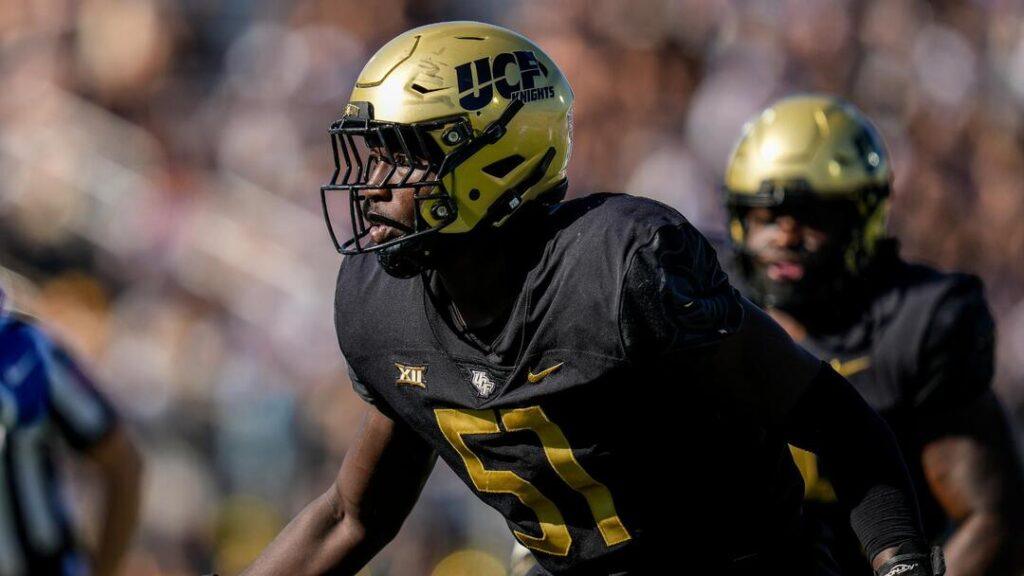
UCF Knights football has reached one of those inflection points that can reshape how a program is evaluated nationally. Malachi Lawrence’s first-round selection by the Dallas Cowboys is not just a draft headline; it is a statement about development, visibility, and UCF’s evolving place in the Big 12.
UCF Knights Football Latest News: Why Malachi Lawrence Matters Now
The latest UCF Knights football story begins with a number: 23. That is where defensive end Malachi Lawrence came off the board in the 2026 NFL Draft, landing with the Dallas Cowboys and giving the Knights another first-round marker in program history.
For UCF, this is bigger than one player’s professional breakthrough. Lawrence became the fifth first-round pick in program history and the highest-drafted defensive player the Knights have produced. In a sport where perception drives recruiting, conference stature, television relevance, and future roster construction, that kind of milestone carries real institutional weight.
I view Lawrence’s rise as a reminder that UCF Knights football is no longer simply selling ambition. It now has another premium NFL example to point toward. His 2025 production seven sacks, 11 tackles for loss, and First Team All-Big 12 recognition gave the Knights a defensive centerpiece with both statistical credibility and professional projection.
The Draft Pick That Reframes UCF’s Defensive Identity
For years, UCF Knights football has been most commonly associated with tempo, offense, quarterback play, and explosive skill talent. Lawrence’s selection helps broaden that identity.
A first-round defensive end changes the conversation. It tells recruits that UCF can develop front-seven players for the NFL. It tells Big 12 opponents that the Knights’ defensive infrastructure deserves closer scrutiny. It tells evaluators that Orlando is producing more than spread-system athletes and high-volume offensive pieces.
That matters because modern college football is increasingly line-of-scrimmage driven. Programs that win consistently in power conferences are rarely built only on speed. They win because they can rush the passer, protect the quarterback, rotate defensive linemen, and survive the physical calendar of a major conference season.
Lawrence gives UCF Knights football a proof point in the hardest area to fake: premium defensive talent.
What Malachi Lawrence Proved At UCF
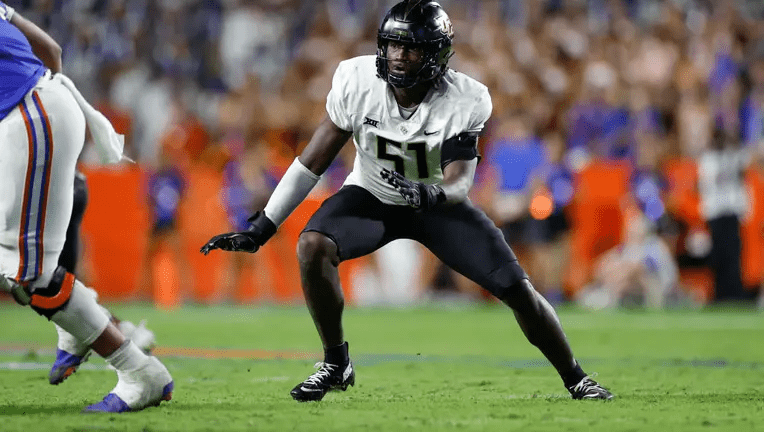
Lawrence’s college profile was compelling because it combined persistence, production, and upward trajectory. He did not become a first-round pick by riding one spectacular flash season. He developed into a consistent edge presence and finished his UCF career with the type of senior-year résumé NFL teams reward.
His 2025 line seven sacks and 11 tackles for loss reflected more than raw athletic ability. It showed disruption. It showed finishing power. It showed a player who could affect game plans and command protection attention.
The First Team All-Big 12 honor gave his production context. He was not simply productive against lesser opposition; he was recognized within one of the sport’s deeper and more physically demanding conferences. That distinction is essential for UCF Knights football because Big 12 validation carries more weight than independent hype.
Why This Boosts Recruiting Immediately
Recruiting is often about evidence. Every program promises development. Every staff sells opportunity. Every campus visit includes a vision of what a player could become.
The difference is proof.
Malachi Lawrence now becomes a living recruiting asset for UCF Knights football. Defensive linemen, edge rushers, linebackers, and hybrid front-seven prospects can look at his path and see a direct line from UCF to the first round. That is powerful in living rooms, official visits, social media campaigns, and transfer portal conversations.
The message is simple: come to Orlando, produce in the Big 12, and the NFL will find you.
That is not marketing fluff. It is now attached to a recent first-round outcome.
The Big 12 Context Makes The Pick More Valuable
UCF’s move into the Big 12 changed the program’s ceiling, but it also changed the burden of proof. The Knights are not competing for attention in the same ecosystem they once occupied. They are now measured against deeper rosters, more physical fronts, and more nationally visible programs.
That is why Lawrence’s success matters so much. He did not become a major draft story in a vacuum. He did it while UCF Knights football was building its identity in a power-conference environment.
The Big 12 stage gives NFL evaluators a stronger weekly sample. It also gives recruits a clearer sense of competition level. For UCF, the formula becomes more persuasive: Big 12 exposure, Florida recruiting access, NFL development, and a campus located in one of the most talent-rich regions in the country.
The National Perception Shift
National perception in college football rarely changes overnight. It moves through moments. A signature win helps. A strong recruiting class helps. A bowl breakthrough helps. A first-round NFL Draft pick also helps, especially when the player fills a premium position.
For UCF Knights football, Lawrence’s draft slot strengthens the argument that the program belongs in deeper national conversations. Not necessarily as a finished Big 12 power, but as a program with the infrastructure, geography, and developmental upside to keep climbing.
That distinction matters. UCF does not need the country to believe it has arrived as a perennial conference champion overnight. It needs the country to believe the climb is credible. Lawrence helps make that case.
What This Means For The 2026 Season
The obvious challenge is that UCF Knights football must now replace its best defensive player. A first-round draft pick leaving the roster creates both pride and pressure.
The pride is easy to understand. Lawrence validates the program’s development model. The pressure is more complicated. His production, leadership, and presence on the edge will not be duplicated casually. The Knights need the next wave of defensive linemen to turn opportunity into reliability.
That is where the 2026 season becomes fascinating. UCF can use Lawrence’s departure as a development story only if the defense does not collapse without him. The program needs rotation players to become starters, young rushers to become finishers, and the defensive staff to prove that the front can remain disruptive without one elite centerpiece.
The Replacement Question Is Now Central
Every major program faces this problem when it sends talent to the NFL. The best teams turn replacement into reload. The rest endure a visible drop-off.
For UCF Knights football, the post-Lawrence defensive equation will shape the season narrative. Can the Knights generate pressure without leaning on one dominant edge rusher? Can they manufacture third-down disruption through scheme, rotation, and ? Can the linebackers and secondary benefit from a front that remains credible?
Those are not small questions. In the Big 12, defensive inconsistency can quickly become a season-long liability. Offenses are too creative, quarterbacks are too experienced, and coaching staffs are too efficient at isolating weaknesses.
A Defining Moment For Player Development
The Lawrence story also raises the standard inside the building. When a program produces a first-round pick, the next question is whether it can do it again.
That is the difference between a great individual success story and a sustainable development pipeline. UCF Knights football now has the chance to turn Lawrence into a template rather than an exception.
The template would include identifying traits early, developing pass-rush technique, building functional strength, creating game-plan responsibility, and exposing players to high-leverage snaps in the Big 12. If UCF can repeat that process, the program becomes more attractive not only to high school recruits but also to transfer portal players seeking a final developmental push before the NFL.
The Recruiting Pitch Has More Edge
The recruiting impact should not be limited to defensive ends. A first-round pick affects the entire roster conversation.
Offensive players want to practice against NFL-caliber defenders. Defensive backs want a pass rush that creates hurried throws. Linebackers want protection from disruptive defensive linemen. Quarterbacks and receivers want a program with national relevance. Parents want evidence that development is real.
UCF Knights football can now fold Lawrence into a broader pitch: this is a Big 12 program in Florida with professional upside, national visibility, and a recent example of elite defensive development.
That is a sharper pitch than potential alone.
What The Cowboys Saw
NFL teams draft traits, production, and projection. Lawrence offered a blend of all three.
His frame, motor, edge presence, and ability to convert opportunity into negative plays made him attractive in a league constantly searching for pass rushers. Edge defenders remain among the most valuable non-quarterbacks in football because they directly affect passing efficiency, protection structure, and late-game outcomes.
The Cowboys’ investment reflects confidence that Lawrence can continue developing at the next level. For UCF Knights football, that evaluation is a public endorsement of the program’s ability to prepare a defensive player for professional demands.
Why First-Round Picks Change Program Memory
College football programs are built on memory as much as metrics. Fans remember breakthrough seasons, signature players, and moments that made the rest of the country pay attention.
Lawrence’s draft night now joins that archive for UCF Knights football.
These moments become reference points. They appear in recruiting graphics, broadcast packages, stadium conversations, and alumni storytelling. They help define eras. They give younger fans names to attach to the program’s rise.
For UCF, a fifth first-round pick is not merely trivia. It is institutional capital.
The Bigger Question: Can UCF Convert Talent Into Wins?
Draft success is valuable, but it does not automatically solve the standings. That is the next frontier for UCF Knights football.
The program must turn NFL-caliber talent into more consistent Big 12 results. Producing a first-round pick proves the ceiling is high. Sustaining conference competitiveness proves the floor is rising.
That difference matters. A program can have elite individual players and still struggle with depth, injuries, game management, or week-to-week consistency. The programs that truly ascend develop stars while also building dependable second units.
For UCF, Lawrence’s success should raise ambition, not soften scrutiny.
The May 2026 Snapshot
As of May 2026, UCF Knights football sits in a pivotal offseason window. The NFL Draft has given the program a national talking point. The roster must absorb the loss of a premier defensive player. The staff must turn visibility into recruiting momentum. The Big 12 schedule will test whether the Knights are progressing from competitive entrant to legitimate conference threat.
That combination makes this moment unusually important.
The Knights are not simply celebrating a draft pick. They are managing what comes after one.
Featured Answer: Why Is Malachi Lawrence’s Draft Pick Important For UCF?
Malachi Lawrence’s first-round selection is important because it strengthens UCF’s credibility as a Big 12 development program, especially on defense. His rise gives UCF Knights football a recent NFL success story at a premium position, helping recruiting, national perception, and the program’s long-term authority.
The Risk Of Overreaction
There is one caution worth making clearly: one first-round pick does not automatically transform a program.
UCF Knights football still has to prove depth. It still has to win line-of-scrimmage battles. It still has to recruit and retain enough high-end talent to withstand Big 12 attrition. It still has to show that the Lawrence outcome can be repeated.
That is the tension that makes the story compelling. The Knights have earned a bigger conversation, but they have not completed the climb. Lawrence’s selection opens a door. The program must now walk through it.
How UCF Should Capitalize
The path forward is clear. UCF should aggressively use Lawrence’s draft success in defensive recruiting, but the message must be specific rather than celebratory.
The Knights should show prospects how he developed. They should explain how his role evolved. They should demonstrate how Big 12 competition sharpened his evaluation. They should connect the dots between production, recognition, and draft value.
That is how UCF Knights football turns a headline into a strategy.
The same principle applies internally. Returning players should not view Lawrence’s departure as a void. They should view it as an opening. Snaps are available. Leadership is available. Production is available. So is national attention.
Why This Moment Feels Different
UCF has had major moments before. The program has won big games, produced stars, generated national debate, and built one of the most ambitious brands in modern college football.
This moment feels different because it is tied to power-conference maturation. UCF Knights football is now being judged in a more demanding competitive environment, and Lawrence’s draft position shows that the program can still produce elite outcomes within that framework.
That is the key point. The Big 12 did not diminish UCF’s developmental appeal. If anything, it may have enhanced it by giving players a more visible platform.
The Long-Term Implications
The long-term implications are significant. If UCF continues producing high-level NFL talent, especially on defense, the program’s recruiting profile changes. Its transfer portal conversations change. Its television narratives change. Its ability to attract assistant coaches and retain staff improves.
Winning remains the central currency, but talent development is the infrastructure behind winning.
Malachi Lawrence’s selection gives UCF Knights football another foundational asset in that infrastructure.
A First-Round Pick Becomes A Program Test
Malachi Lawrence’s rise to the first round is a milestone worth celebrating, but its real value will be measured by what UCF does next. The Knights now have a stronger recruiting pitch, a sharper defensive identity, and a fresh piece of national validation at a time when Big 12 credibility matters more than ever.
The opportunity is clear: turn one elite player’s success into a repeatable model. If UCF Knights football can do that, Lawrence’s draft night will be remembered not only as a personal breakthrough, but as a signal that the program’s next stage had truly begun.