

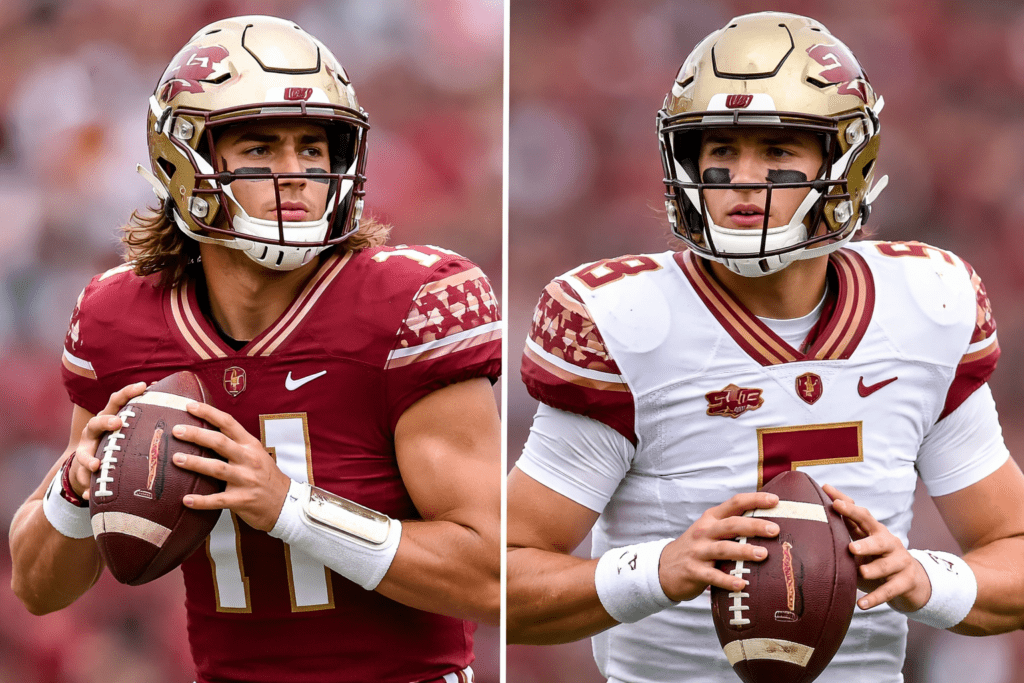
For Florida State Seminoles football, spring practice is doing what it is supposed to do: forcing the most important questions into the open before the season arrives. And right now, no question matters more than who will take control at quarterback while a surging defense sets the early tone for 2026.
I see a program at a familiar crossroads, but with a different kind of edge. This is not simply a battle over a starting job. It is a test of identity, tempo, and leadership for a team trying to establish what kind of season it intends to have.
A Quarterback Competition That Will Shape The Season
The biggest storyline in Tallahassee is the competition between Ashton Daniels and Kevin Sperry. That much is clear. What makes it especially significant is not just that two quarterbacks are battling for snaps, but that the staff is framing the decision around control of the offense rather than raw talent alone.
That distinction matters.
Quarterback competitions often get reduced to arm strength, mobility, or experience. Those traits matter, of course, but they do not settle the larger question. The staff wants to know which player can truly run the operation, command the huddle, process quickly, and turn practice performance into offensive ownership. In other words, the issue is not who can flash. It is who can lead.
That puts Daniels and Sperry under a more demanding lens. Every rep becomes a judgment on poise, timing, decision-making, and consistency. Every drive becomes a measure of whether the offense looks confident or hesitant. In the spring, that kind of evaluation is often more revealing than the stat sheet.
What stands out to me is how tightly this competition appears to be running as spring practice closes. There is no obvious runaway favorite in the public picture. That creates urgency, but it also creates opportunity. Competitive pressure at quarterback can sharpen a room, elevate accountability, and give the staff a better understanding of what the offense can realistically become by opening week.
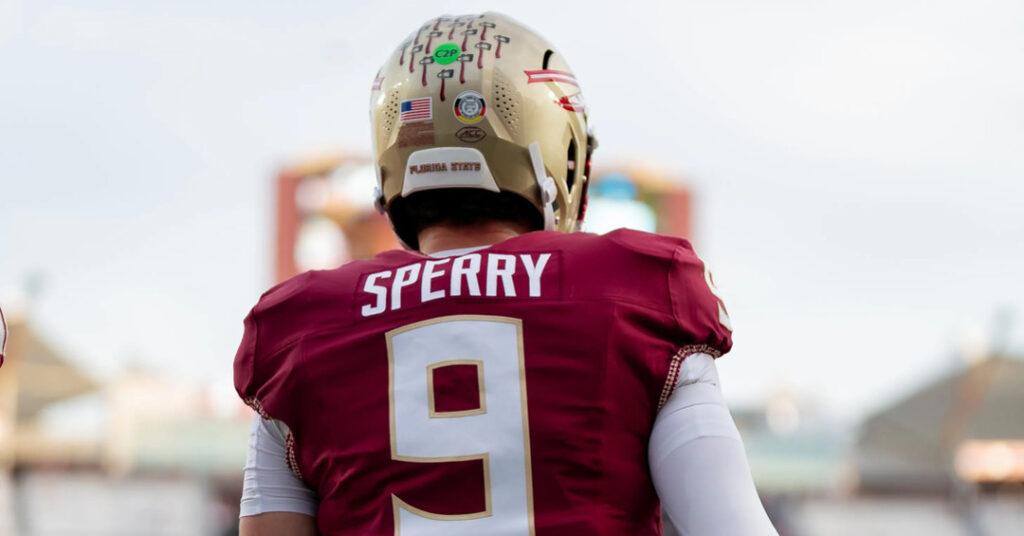
Why “Owning The Offense” Is The Real Standard
The phrase that hangs over this competition is simple: who is owning the offense?
That is the right question, and it tells us a great deal about where Florida State is in its development. The Seminoles do not just need a player who can survive the position. They need one who can set the rhythm of the entire team.
To own the offense means more than delivering the play call correctly. It means anticipating pressure, getting the ball out on time, adjusting protections, staying ahead of the chains, and making the players around you better. It also means showing the kind of command that teammates immediately recognize. Locker rooms know when a quarterback is truly in charge.
This is why the battle between Daniels and Sperry feels so consequential. The winner will not simply inherit the offense; he will define its personality. If one quarterback brings greater composure in structure, that could point toward a more efficient, lower-risk system. If the other brings more explosiveness and improvisational energy, the offense may lean into a different style. The decision will ripple outward to the line, the receivers, the running game, and even game management.
In my view, the staff’s standard is a healthy sign. Programs with real ambitions do not settle for competence at quarterback. They look for command.
A Defense That Is Already Setting The Tone
While the offense searches for its leader, the defense has been winning the spring narrative.
That may be the most encouraging development of all for Florida State. Strong defensive spring performances can sometimes reflect offensive inconsistency, and that possibility should not be ignored. But they can also signal a unit with speed, cohesion, and confidence that is beginning to impose itself. In Tallahassee, the signs point to a defense that could become the backbone of the 2026 team.
I think that matters enormously because defenses with early spring momentum tend to create a different atmosphere across the entire roster. Practices become more physical. Standards rise. Margins tighten. The offense has to become sharper simply to function. That can be frustrating in the moment, but it often produces a harder, more disciplined team by the time the season begins.
For Florida State, a defense dominating scrimmages suggests a group that is ahead of schedule in communication and execution. It suggests pursuit, disruption, and an ability to control possessions rather than merely react to them. And it gives the Seminoles a stabilizing force while the quarterback race plays out.
If the defense is as strong as it currently looks, Florida State may not need the offense to be spectacular immediately. It may only need the offense to be efficient, composed, and timely. That changes the entire calculus of the quarterback competition.
The Balance Florida State Needs In 2026
This is where the story becomes more interesting than a simple spring quarterback race.
Florida State does not appear to need a quarterback to carry the entire program from day one. It needs one to complement what could be a strong defensive foundation. That is a much different assignment, and in some ways a more manageable one.
The ideal outcome for the Seminoles is balance: a defense capable of dictating games, paired with an offense that avoids self-inflicted damage and produces enough explosive moments to capitalize on field position and momentum. That formula can win a lot of games, especially early in a season when offensive systems are still settling.
There is also a broader program question here. When a team enters spring with a live quarterback battle and a defense that is already asserting itself, it often reveals where the internal confidence sits. Right now, I see a team that appears comfortable leaning on its defensive structure while waiting for one quarterback to seize control.
That is not a weakness. It can be a very practical path into a new season.
For readers tracking the broader outlook of Florida State Seminoles football, the most important thing to watch is not just who wins the job, but how decisively he wins it. If the answer becomes clear before the summer, the offense will have time to build continuity. If the competition drags on without separation, then the concern shifts from intrigue to uncertainty.
What To Watch As Spring Turns To Summer
As I assess Florida State coming out of spring, I am watching three things.
First, does one quarterback begin to show unmistakable command in the small details: cadence, timing, situational awareness, and red-zone efficiency? Second, does the offense start responding to that player with more confidence and sharper execution? Third, does the defense continue to look dominant once the offense settles and adjusts?
Those answers will tell us far more than any headline declaration about a spring winner.
Florida State’s internal tone entering 2026 feels serious, competitive, and somewhat unfinished, which is exactly what spring is designed to reveal. There is obvious tension at the most important position on the field, but there is also real promise in the way the defense is developing. Together, those two realities create a team worth watching closely.
The reason this matters right now is simple: spring is where the outline of a season first becomes visible. For Florida State, that outline is already taking shape around a high-stakes quarterback competition and a defense that looks ready to lead. If one passer can truly own the offense, the Seminoles may enter 2026 with the balance, toughness, and clarity needed to become far more than a team still searching for answers.