

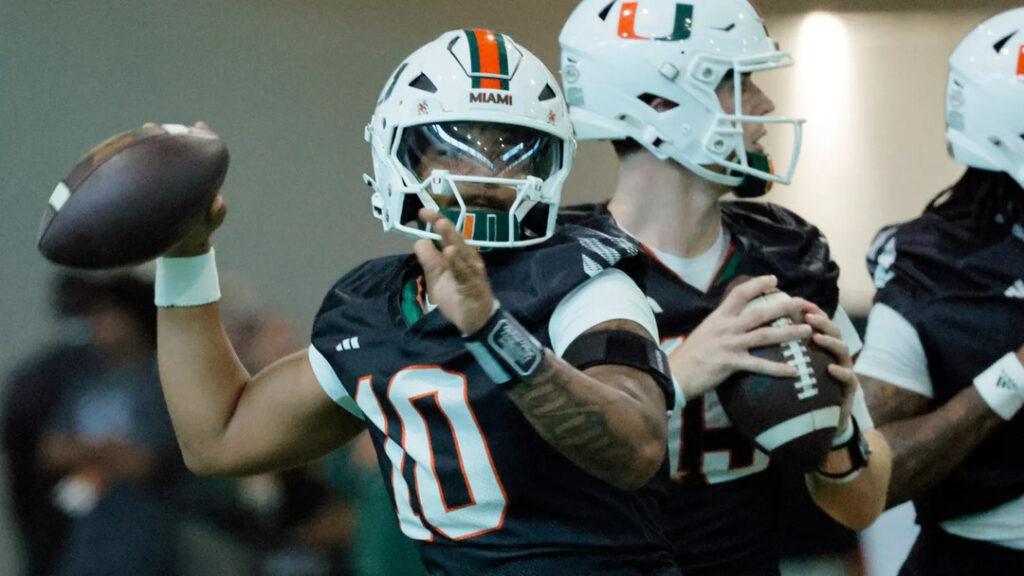
Miami’s spring football window did not merely close with a handful of practice notes and a few highlight throws. It ended with the unmistakable sense that the Hurricanes are entering one of the more consequential offensive transitions of the Mario Cristobal era.
For a program trying to turn momentum into staying power, Miami Hurricanes Spring Football has become more than an offseason checkpoint. It is the first serious look at whether a roster built through recruiting, development, and transfer-portal aggression can evolve from promising to dangerous.
A Spring Built Around Quarterback Urgency
Every major Miami offseason seems to begin at quarterback, and 2026 is no exception. That is not a weakness. In the modern college game, quarterback clarity is infrastructure. Without it, even talented rosters drift. With it, an offense can form an identity before the pressure of September exposes every flaw.
Darian Mensah’s arrival has given Miami a legitimate focal point. He is not being treated like a developmental lottery ticket or a placeholder. He entered spring with the profile of a player expected to compete immediately, and by the end of the spring game, he had done enough to make the conversation around Miami’s offense feel substantially different than it did at the start of camp.
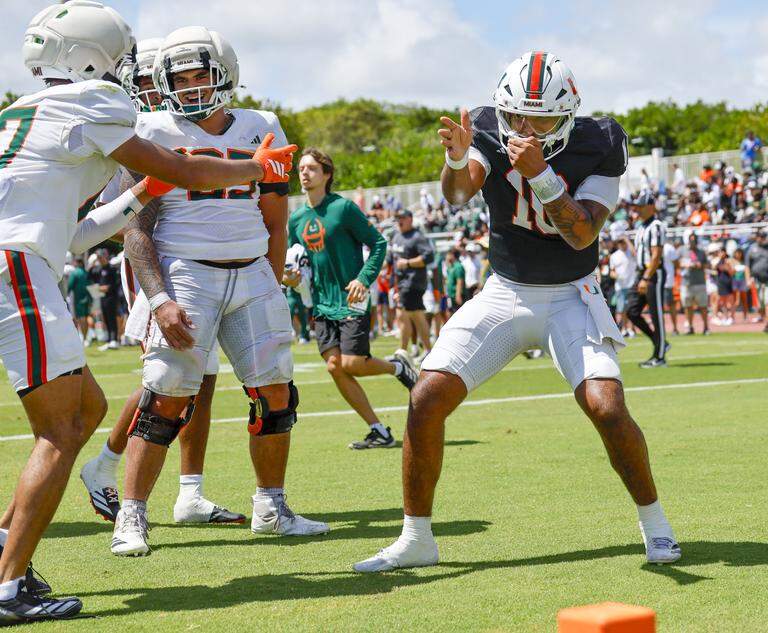
Mensah’s spring-game performance mattered less because of the raw touchdown count, though multiple scoring throws always change the tenor of an offseason, and more because of what those throws suggested. He looked comfortable operating within the structure of the offense. He showed timing. He appeared willing to let routes develop. Most importantly, he began creating visible chemistry with a receiving group that Miami needs to become more reliable, more explosive, and more efficient.
Spring football can mislead. Defenses are limited. Veterans are protected. Install packages are incomplete. Coaches rarely reveal the full scope of what they intend to run in the fall. But spring can still reveal whether a quarterback processes the field naturally, whether the ball comes out on time, and whether teammates respond to his command. In that regard, Mensah’s spring was meaningful.
Darian Mensah’s Emergence Changes The Offensive Conversation
The most important thing Mensah offered Miami this spring was not a single spectacular play. It was the suggestion of order.
Miami’s offense needs a quarterback who can organize chaos. That means getting protections aligned, handling tempo, punishing soft coverage, and avoiding the kind of negative plays that turn talented drives into empty possessions. Mensah’s early command matters because Miami is not building an offense from scratch. It is trying to refine one that has the personnel to stretch defenses vertically and horizontally but still needs week-to-week consistency.
His spring-game touchdowns gave the staff and fan base a visible proof point, but his broader value lies in how he can shape the passing game. Miami has been searching for a quarterback who can combine aggression with discretion. The Hurricanes do not need a reckless downfield gambler. They need a passer who can make explosive throws without turning every possession into a volatility exercise.
That distinction is central to the 2026 outlook. A more explosive Miami offense will not necessarily be one that throws deep on every series. It will be one that forces defenses to defend every blade of grass. Mensah’s arm talent, timing, and early rapport with receivers give Miami a pathway toward that kind of multiplicity.
This is where Miami Hurricanes Spring Football becomes especially revealing. The spring did not provide final answers, but it showed the outline of an offense with greater vertical intent, more passing-game rhythm, and a quarterback capable of becoming the organizing force.
The Passing Game Looks Sharper, But Not Finished
The most encouraging development of Miami’s spring was the passing game’s apparent jump in energy. The ball moved. Receivers created separation. Young players were not merely standing in line behind veterans; they were being placed in situations where the staff could evaluate whether they belonged in the fall rotation.
That matters because modern college offenses cannot survive with one primary receiving option and a collection of complementary pieces. Defenses are too sophisticated. Coordinators are too willing to bracket, disguise, and pressure. A passing game becomes truly difficult to defend when the quarterback has answers at every level: quick-game outlets, intermediate separators, vertical threats, tight ends who can punish linebackers, and backs who can turn checkdowns into efficient gains.
Miami’s spring suggested movement in that direction. The offense looked more capable of creating chunk plays, and Mensah’s connection-building accelerated the process. Still, spring optimism should be kept in context. Chemistry built in April is not the same as execution under live ACC pressure in October. Timing that looks clean in a controlled scrimmage must survive third-and-long, hostile noise, disguised coverage, and blitz packages designed specifically to cloud the quarterback’s first read.
That is why Miami’s passing-game progress should be viewed as encouraging rather than conclusive. The Hurricanes appear more explosive than they were a year ago, but explosiveness is only half of the equation. The next step is reliability.
Why Explosiveness Alone Is Not Enough
Explosive offense is seductive. It travels well in highlights, fuels recruiting buzz, and gives a team the ability to erase deficits quickly. But the best offenses are not simply explosive. They are sustainable.
For Miami, the challenge is to avoid becoming a team that lives only on big plays. A 40-yard touchdown can change a game, but so can a six-minute drive that protects a lead, settles the defense, and forces an opponent to play from behind. The Hurricanes’ offensive evolution depends on finding the balance between vertical ambition and situational discipline.
That balance begins with down-and-distance management. First-down efficiency is often the hidden foundation of offensive success. If Miami can consistently create second-and-medium, the playbook opens. Mensah can use play action. The run game becomes more credible. Receivers get cleaner releases. The offensive line can attack rather than retreat.
If Miami falls into second-and-long and third-and-obvious too often, the offense becomes more fragile. Pass protection faces greater stress, receivers have less room to manipulate leverage, and Mensah must carry a heavier burden.
The spring flashes were real. The next question is whether Miami can turn those flashes into a repeatable operating system.
Freshmen Reps Reveal A Long-Term Offensive Plan
One of the more important signs from spring was the meaningful involvement of freshmen. That is not a small detail. It reflects how Miami is thinking about roster construction and competitive depth.
Freshman reps in spring are not ceremonial when a program is serious about raising its floor. They allow coaches to test mental processing, physical readiness, and competitive response before the roster settles into fall hierarchy. They also create pressure on older players. When freshmen are treated as real options, veterans understand that playing time has to be earned again.
For Miami, this is especially important on offense. The Hurricanes need more than a strong starting group. They need a developmental pipeline that can absorb injuries, sustain tempo, and prevent late-season decline. A team that expects to contend cannot be one injury away from abandoning its offensive identity.
Young players also bring a different kind of energy to spring. They are less shaped by past limitations and more open to rapid growth. Coaches can mold their habits early, especially in route discipline, blocking effort, protection recognition, and ball security. Those details may not dominate spring-game headlines, but they determine who is trusted when the season tightens.
The freshmen getting meaningful work this spring suggests Miami is not merely assembling a one-year offense around Mensah. It is trying to build continuity.
Veteran Caution Was Smart, Not Concerning
Some key veterans were held out or limited during spring, and that should not be interpreted as a red flag on its own. In fact, for a roster with established contributors, caution is often the correct approach.
Spring football is about evaluation, installation, and development. It is not about proving a veteran can absorb unnecessary contact in April. Coaches have to balance competitive sharpness with roster preservation. The more valuable a player is to the fall plan, the more carefully his workload must be managed.
This is particularly true for positions exposed to repeated collisions. Skill players, linemen, and defensive veterans often benefit more from targeted technical work than from every live rep available. The objective is not to win spring. The objective is to reach fall camp with a healthier, clearer, and deeper roster.
The added benefit is that younger players receive more work. When veterans are limited, coaches get cleaner evaluations of the next wave. That helps define depth charts, special-teams roles, and emergency options. Miami’s spring structure therefore served two purposes: protect known assets and accelerate unknown ones.
That is exactly how mature programs operate.
The Offensive Line Remains The Swing Factor
Quarterback play will dominate the public conversation, but Miami’s offensive ceiling may still depend on line play. Cristobal’s identity has always leaned toward physicality, trench development, and a belief that offensive control begins up front. That philosophy remains central to the Hurricanes’ 2026 outlook.
Mensah can elevate the passing game, but he cannot do it alone. His success depends on protection integrity, especially against pressure looks designed to force hurried decisions. If the offensive line gives him a clean platform, Miami can attack intermediate windows and stretch defenses vertically. If protection becomes inconsistent, the offense risks narrowing into quick throws and improvisation.
The run game is equally important. A credible rushing attack changes the math for everyone. It slows pass rushers, holds linebackers, and creates play-action windows. It also prevents defenses from treating Miami as a pass-first team that can be pressured into mistakes.
The spring flashes in the passing game should not obscure this reality: Miami’s offense will only become truly dangerous if the line allows it to stay multiple. The Hurricanes do not need to be old-fashioned, but they do need to be physically credible. Without that, explosiveness becomes easier to defend.
Chemistry Is The Offseason Currency
Quarterback-receiver chemistry is often discussed casually, but in high-level football it is a technical asset. It determines whether a back-shoulder throw arrives before the defensive back can react. It shapes option routes. It affects scramble rules, red-zone timing, and third-down trust.
Mensah building chemistry quickly is therefore one of the most significant developments from Miami’s spring. The throws that become decisive in the fall are rarely improvised from nothing. They are built through repetition: same leverage, same release, same landmark, same timing. By April, the best offenses are not complete, but they have begun forming shared language.
That shared language matters most in high-leverage situations. Third-and-six. Two-minute drill. Red zone. Backed up near the goal line. Those moments expose whether a quarterback and receiver see the field the same way. A route that is technically open is not always functionally open unless both players anticipate the same window.
Miami’s spring indicated progress, but chemistry is fragile if it is not reinforced. The summer will matter enormously. Player-led work, film study, timing sessions, and fall-camp refinement will determine whether April’s promising moments become September’s reliable answers.
The Quarterback Battle Still Has Value
Even if Mensah has emerged as the leading figure, the broader quarterback competition still carries value. A healthy quarterback room raises practice intensity, protects the team against injury, and prevents complacency.
The most productive quarterback battles are not always open-ended dramas. Sometimes they clarify roles. They push the presumptive starter to sharpen details. They help the staff identify a backup who can execute the offense without forcing a complete schematic rewrite. They also reveal which younger players are ready to handle pressure and which need more time.
For Miami, that is crucial. The Hurricanes cannot afford a quarterback room built only around one player. In a long season, depth matters. Even if Mensah becomes the clear starter, the staff needs confidence in the next option. That confidence is built in spring and tested in fall.
A strong quarterback room also changes practice. Defensive backs get better looks. Receivers get more accurate balls. Offensive tempo improves. The entire roster benefits when the quarterback position is competitive and functional.
Mensah may be the headline, but the room still matters.
Offensive Identity Is Beginning To Take Shape
Miami’s spring suggested an offense moving toward greater balance between structure and explosiveness. That is the right direction.
The Hurricanes do not need to chase novelty for its own sake. They need an identity that matches their personnel. With Mensah, emerging receivers, young contributors, and a staff committed to physical development, Miami has the pieces to create an offense that can attack vertically while still leaning on discipline.
The most effective version of this offense would be layered. Early downs would blend run looks, quick throws, and play-action concepts. Intermediate routes would stress linebackers and safeties. Vertical shots would come from formation leverage rather than desperation. The red-zone package would emphasize timing, size, motion, and quarterback decisiveness.
That kind of offense requires patience. It also requires self-scouting. Miami must understand what it does well and avoid installing too much simply because the roster appears talented enough to handle it. Complexity is only useful when it creates clarity for the offense and confusion for the defense. If it does the opposite, it becomes decoration.
The spring signs point to a more dynamic attack. The next step is refinement.
The Standard Has Changed In Miami
The conversation around Miami football is different now because expectations have changed. This is no longer a program asking whether it has enough talent to compete nationally. The question is whether it can consistently convert talent into results.
That distinction matters. Programs with real ambition are judged by execution, not potential. Spring hype, recruiting rankings, and transfer additions can create momentum, but they do not win road games, protect leads, or survive injuries. Miami’s 2026 offense will be judged by how it performs when opponents have film, when early scripts expire, and when games become situational.
That is why Mensah’s emergence is so important but not sufficient. He gives Miami a credible answer at the sport’s most important position. Now the staff must build the ecosystem around him: protection, route discipline, tempo, run-game support, and situational mastery.
The Hurricanes have enough offensive talent to be dangerous. The question is whether they can become dependable.
What The Spring Game Actually Told Us
Spring games are often overinterpreted, but they are not meaningless. Miami’s spring finale told us several important things.
It showed that Mensah can create momentum quickly. It showed that the passing game has more juice. It showed that freshmen are not being hidden. It showed that the staff is willing to protect veterans while still using spring as a serious evaluation period. It also showed that the offense, while improved, remains a work in progress.
That last point is essential. The best reading of Miami’s spring is not blind optimism. It is informed optimism. The Hurricanes look more explosive, more intriguing, and potentially more balanced. But they still need consistency, health, and sharper execution before the offense can be considered championship-caliber.
The danger for any talented spring team is believing flashes are the same as proof. Miami must resist that. Spring should create urgency, not satisfaction.
The Summer Will Decide The Offense’s Trajectory
The period between spring practice and fall camp is often where good offenses separate from inconsistent ones. Coaches can install concepts, but players build ownership during the summer.
For Mensah, the summer is about command. He must deepen timing with receivers, sharpen protection communication, and become fully fluent in the offense’s answers. For receivers, it is about precision. Explosive plays often begin with small details: release angle, stem discipline, eye control, and finishing through contact. For the offensive line, it is about cohesion. Five talented linemen are not the same as one connected unit.
The summer will also test leadership. Mensah emerging as a leader in spring is encouraging, but leadership becomes more meaningful when coaches are not directing every moment. The best quarterbacks take control of the offseason. They organize work. They demand standards. They make the offense feel player-owned before camp begins.
If Mensah does that, Miami’s spring momentum can become something more durable.
Why Miami’s Offensive Evolution Matters Nationally
Miami is not just another program trying to improve its passing game. The Hurricanes occupy a unique place in college football’s national imagination. When Miami has speed, confidence, and quarterback play, the sport pays attention.
That is why the 2026 offensive transition matters beyond Coral Gables. A more explosive Miami changes the ACC race. It affects recruiting battles across Florida and the Southeast. It raises the stakes for every opponent on the schedule. It also tests whether Cristobal’s program-building model can produce not only physical teams, but complete ones.
The modern championship contender must be able to win multiple styles of game. It must score quickly when needed and control tempo when required. It must develop young players without sacrificing veteran accountability. It must use the transfer portal without becoming dependent on short-term fixes. Miami’s spring offered hints that the Hurricanes are working toward that balance.
Hints are not guarantees. But they are meaningful.
The Risk Hidden Inside The Optimism
The biggest risk for Miami is not lack of talent. It is unevenness.
A team can look explosive and still lose rhythm. A quarterback can flash brilliance and still struggle against disguised pressure. Young players can generate excitement and still miss assignments. Veterans can return healthy and still need time to integrate into a changing offensive structure.
That is the tension surrounding Miami’s 2026 offense. The ceiling appears higher. The passing game looks more dangerous. Mensah looks capable of giving the Hurricanes a real command presence. But the floor will depend on details that are less glamorous than spring touchdowns.
Can Miami avoid drive-killing penalties? Can it protect the quarterback against elite fronts? Can it finish red-zone opportunities? Can it remain efficient when explosive plays are unavailable? Can it win offensively on days when timing is slightly off?
Those are the questions that will decide whether the Hurricanes are merely exciting or genuinely formidable.
Miami Hurricanes Spring Football Leaves A Clear Takeaway
The clearest takeaway from Miami Hurricanes Spring Football is that the offense has moved into a more interesting phase. Darian Mensah has given the quarterback conversation shape. The passing game has shown signs of becoming more explosive. Young players are entering the picture. Veterans are being managed with the long season in mind.
This is what a serious spring should produce: not final answers, but sharper questions.
Miami now has a framework. The quarterback appears capable. The receiving chemistry is developing. The offensive identity is becoming more ambitious. The staff has created competition without losing sight of preservation. The next challenge is transforming spring momentum into fall reliability.
That is where the 2026 Hurricanes will define themselves.
Conclusion: Miami’s Opportunity Is Real, But So Is The Test
Miami enters the next phase of the offseason with something every ambitious program wants: a credible quarterback story, visible offensive growth, and enough young talent to suggest the ceiling is still rising. That makes this moment timely and important. The Hurricanes are not simply trying to look better in April. They are trying to build an offense that can withstand the demands of a full season.
The opportunity is clear. If Mensah’s leadership continues to grow, if the passing game becomes consistent, and if the offensive line gives the system stability, Miami can field an attack that is more explosive than last year and better equipped to compete at the highest level.
The risk is equally clear. Spring flashes fade quickly when they are not backed by execution, depth, and discipline. Miami’s challenge now is to turn promise into proof. That is why Miami Hurricanes Spring Football matters so much right now: it offered the first glimpse of an offense with real upside, but the season ahead will determine whether that upside becomes Miami’s new standard.