

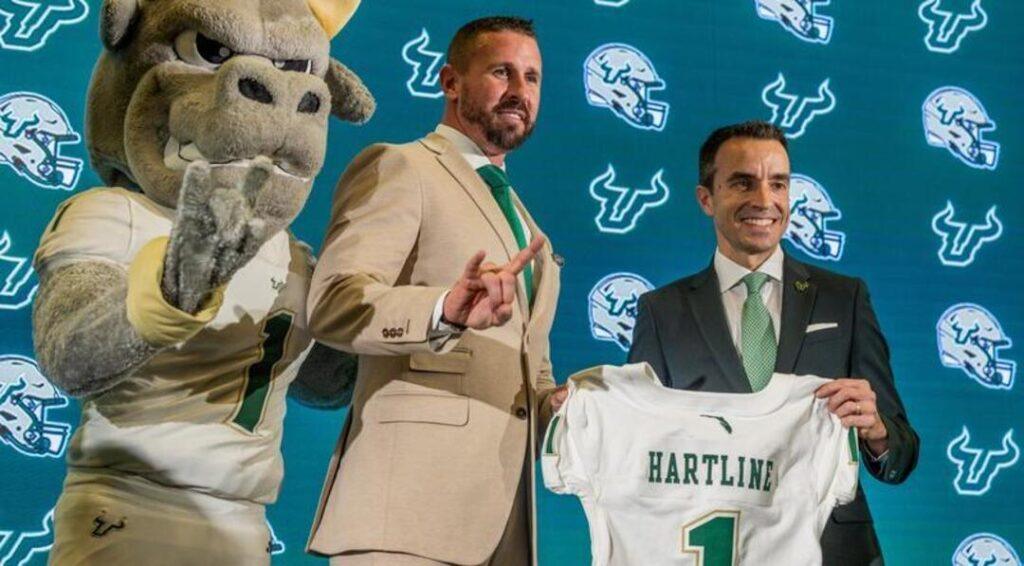
The scale of change unfolding in Tampa is hard to overstate. In a sport where continuity usually determines who rises and who stalls, USF football is trying something far more ambitious: a rapid, roster-wide reset under a first-year head coach with a reputation for offensive precision and big-stage expectations.
I see this moment as one of the most consequential transitions in the program’s modern history. South Florida is not easing into a new identity. It is attempting to build one almost overnight, with Brian Hartline arriving for Year 1 and immediately engineering one of the most aggressive overhauls in the country.
A Program Choosing Urgency Over Patience
When a school changes coaches, the standard script is familiar. The new staff evaluates what it inherited, preserves as much stability as possible, and gradually introduces its own vision over two or three recruiting cycles. That is not the model taking shape at South Florida.
Instead, the Bulls have embraced urgency. Hartline, the former Ohio State offensive coordinator, stepped into the job and quickly reshaped the roster with extraordinary force. USF added 58 new players this spring, including 41 transfers, a number that places the Bulls among the most aggressive roster rebuilds outside the power conferences. This is not a tune-up. It is a reconstruction project with the pace of a startup and the pressure of a major-market franchise.
That matters because college football’s current structure rewards decisiveness. With the transfer portal now central to roster building, coaches no longer have to wait years to impose their blueprint. They can change the competitive profile of a team in months. The risk, of course, is that rapid change can create instability as easily as it creates momentum.
What Hartline is betting on is simple: talent acquisition and system fit can accelerate a program faster than incremental development alone. It is a bold wager, but in the current landscape, it is also a rational one.
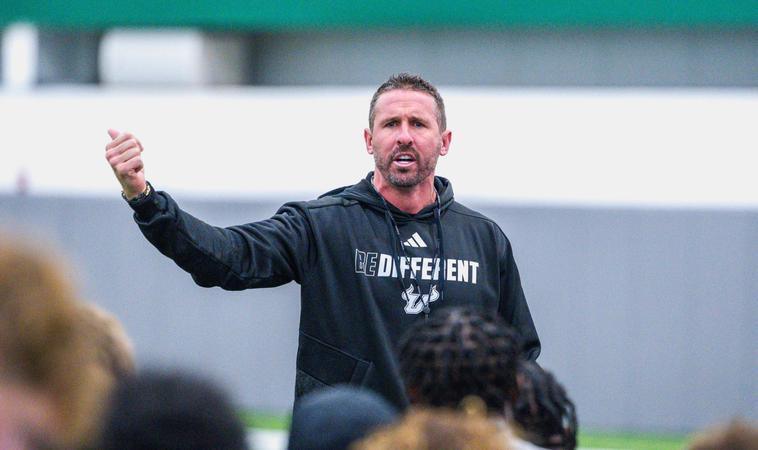
Brian Hartline Brings a Different Kind of Profile
Hartline’s arrival is notable not just because he is new, but because of the kind of pedigree he brings. He comes from one of college football’s highest-pressure environments, where offensive production is scrutinized weekly and roster expectations are championship level. That background carries real weight.
I view Hartline as a coach whose reputation has been shaped by elite standards. At Ohio State, offensive success was never treated as optional, and personnel management was inseparable from scheme design. That mindset tends to travel. Coaches from that environment usually arrive with a sharper sense of how a modern offense should be assembled, what traits matter most, and how quickly gaps in the roster must be addressed.
For USF, that is the attraction. The program is not simply hiring a new face. It is importing a methodology built around speed, efficiency, and talent alignment. Hartline’s challenge now is to prove that what works at a national brand can be adapted to a program operating in a different competitive and financial lane.
That adaptation will determine whether this transition becomes transformational or merely turbulent.
The Numbers Explain the Scale of the Rebuild
The most revealing part of this offseason is not rhetoric. It is arithmetic. The Bulls are trying to remake themselves with a volume of change that demands attention.
| Roster Reset Metric | Total |
|---|---|
| New Players Added This Spring | 58 |
| Transfers Added | 41 |
| Head Coach Status | Year 1 Under Brian Hartline |
| Rebuild Outlook | One of the largest in the country |
Those numbers tell a story on their own. A roster influx of that size affects every layer of a team: the depth chart, practice tempo, positional competition, leadership structure, and even the emotional chemistry of the locker room. Returning players are no longer simply defending roles against familiar teammates. They are reintroducing themselves in a new ecosystem, one where the coaching staff is evaluating the entire roster through a different lens.
I think this is where the rebuild becomes fascinating. Large-scale roster turnover is often discussed as a talent story, but it is equally a culture story. Coaches can import speed, size, and experience. They cannot instantly import trust. That has to be built through repetition, accountability, and shared adversity.
What This Strategy Is Really Trying To Solve
Every major roster overhaul is, at its core, an admission. It says the existing structure was not enough, or at least not enough to support the new coach’s ambitions. Hartline’s approach suggests he believes USF needed more than cosmetic adjustments.
The likely goals behind a rebuild of this magnitude are easy to identify:
- Raise the baseline talent level across multiple position groups
- Create immediate competition rather than deferred development
- Install a roster tailored to the coaching staff’s offensive and overall team philosophy
- Compress the timeline for relevance in a fast-moving conference environment
That strategy is especially important for a program trying to establish durability rather than just chase a one-off breakthrough. In college football, there is a significant difference between a team that surprises opponents for one season and a program that consistently dictates terms. Hartline appears to be aiming for the latter, even if the short-term turbulence is unavoidable.
To me, that is the most serious sign of intent. This is not a maintenance hire. It is an attempt to reset the trajectory of the program.
Why The Transfer Portal Makes This Possible
Five years ago, a rebuild on this scale would have been nearly impossible. The traditional recruiting calendar and stricter movement rules limited how quickly a coach could alter the shape of a roster. That era is over.
The transfer portal has created a new competitive reality, one in which roster engineering can happen at industrial speed. Programs with a clear plan, a strong evaluation model, and a persuasive pitch can add dozens of players in a single cycle. That does not guarantee success, but it does give staffs an unprecedented ability to attack weaknesses immediately.
For anyone trying to understand the broader context of roster change in the sport, USF football exists inside a system where movement is no longer an exception. It is structural.
That broader environment works in Hartline’s favor. He does not have to wait for freshmen to mature before testing his ideas. He can accelerate competition now. He can demand quicker adaptation now. And he can judge, with unusual speed, whether his roster blueprint is functional.
The Upside Is Obvious, But So Is The Volatility
I would argue that this overhaul creates a wider range of possible outcomes than most offseason narratives admit. The upside is real. A large transfer class can raise competence quickly, especially if many additions arrive with game experience and physical maturity. Position groups that were thin can become functional in a matter of months. Units that lacked playmaking can suddenly look more dynamic.
But volatility is the price of speed.
A roster this new has to answer difficult questions in real time. How quickly can players absorb terminology? How well do position rooms communicate? Who becomes the emotional center of the team when so many newcomers are still learning the place, the staff, and each other? What happens when adversity hits in September and there is no deep reservoir of shared history to lean on?
Those are not small questions. They are often the difference between a fast start that lasts and one that collapses under strain.
I think that is why this offseason should be read with both excitement and discipline. It is reasonable to admire the ambition while also recognizing that cohesion cannot be fast-tracked as easily as personnel.
What Success Would Actually Look Like In Year One
There is a temptation in college football to judge every rebuild through wins alone. I understand that instinct, but I think it can miss the real indicators of whether a first year is building something sustainable.
For USF, success under Hartline should be measured through a few deeper signals:
- The offense shows a clear identity rather than generic improvisation
- Competition produces sharper execution instead of confusion
- Transfer additions strengthen depth rather than merely inflate numbers
- The team looks more organized in critical situations late in games
- The program establishes a style players can sell in future recruiting
Those markers matter because Year 1 is rarely about perfection. It is about coherence. If South Florida looks faster, better aligned, more aggressive, and more certain of what it wants to be, that will matter almost as much as the record itself.
In my view, a successful first season would prove that Hartline’s methods translate, that the roster reshaping served a purpose beyond headlines, and that the Bulls are no longer just reacting to change in the sport but using it strategically.
Why This Matters Right Now
This moment matters because college football has entered an era where mid-tier programs can either be overwhelmed by constant change or weaponize it. South Florida is choosing the second path. Hartline’s first year is not just a coaching debut; it is a test case in whether bold roster management can compress the rebuild cycle and create immediate relevance.
That is why this offseason deserves real attention. USF football is attempting one of the largest and most aggressive resets in the country, and the outcome will say something important about where the sport is headed. If this works, it will reinforce a new truth of modern college football: the programs willing to move fastest may be the ones best positioned to matter next.