

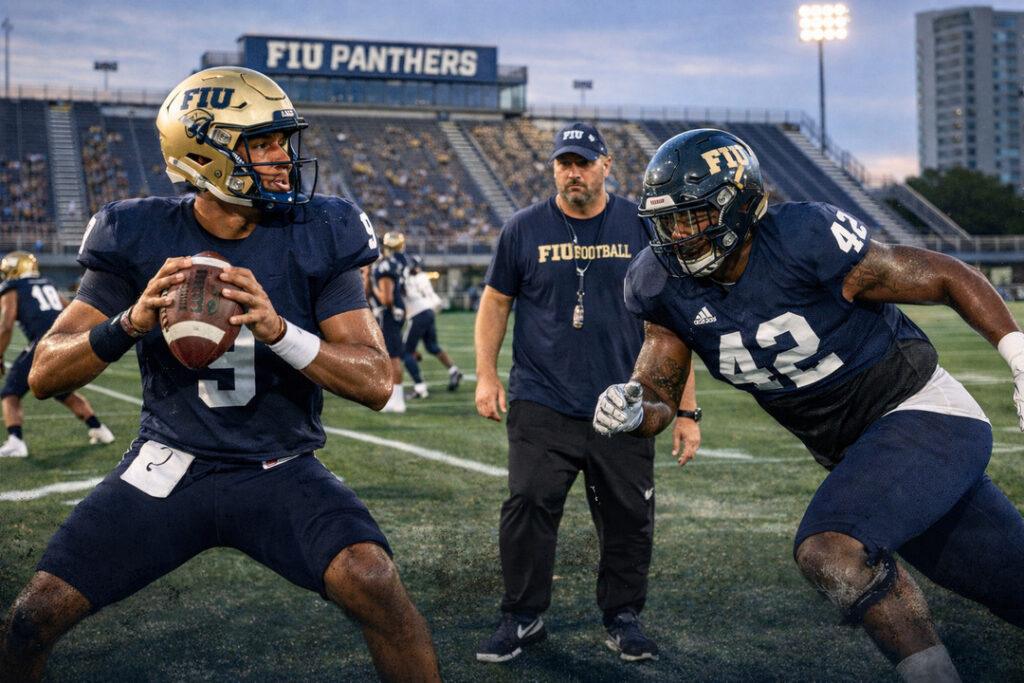
From my perspective, the FIU Panthers football rebuild is one of the more quietly intriguing stories in college football right now. While the spotlight often shines on powerhouse programs, FIU is working through the kind of foundational transformation that ultimately determines whether a team can sustain long-term success.
This isn’t about quick fixes or headline-grabbing transfers. It’s about building a system defensively, structurally, and culturally that can compete in Conference USA. And while the results may not yet match the ambition, the direction is becoming clearer.
A Program in Transition: Understanding the Current Phase
Rebuilding in college football is rarely linear. FIU finds itself in a stage where progress is measured less by wins and more by consistency, identity, and player development.
Competing in the Conference USA presents both opportunity and challenge. The conference is known for its unpredictability teams can rise quickly, but they can just as easily fall behind if depth and discipline are lacking. For FIU, the mission right now is simple: close the gap between competitiveness and contention.
Defensive Structure: The Foundation of the Rebuild
If there is one area that defines the FIU Panthers football rebuild, it is the emphasis on defense. From what I’ve observed, the coaching staff understands that defensive stability is often the fastest way to elevate a developing program.
This means focusing on:
- Gap discipline and tackling fundamentals
- Improved pass coverage schemes
- Rotational depth to maintain energy late in games
The goal is not just to stop opponents, but to create a reliable backbone that keeps games within reach.
A strong defensive identity does more than limit scoring it builds confidence across the entire roster. When players trust the system, execution improves, and close games start to tilt in your favor.

Recruiting Pipeline: Building the Future from the Ground Up
No rebuild is sustainable without recruiting, and FIU is investing heavily in developing a consistent talent pipeline.
Located in one of the most talent-rich regions in the country, FIU has a strategic advantage. South Florida produces elite high school prospects every year, and the challenge is converting that proximity into commitment.
From my perspective, the key recruiting priorities include:
- Retaining local talent that might otherwise leave the region
- Identifying undervalued prospects who fit the system
- Building relationships with high school programs
This isn’t about winning every recruiting battle it’s about winning the right ones.
The Quarterback Factor: A Defining Variable
Every rebuilding team eventually reaches a point where progress hinges on one position: quarterback. For FIU, this is where the next leap must happen. A developing program can improve defensively and recruit well, but without stability under center, it struggles to sustain drives and control games.
The ideal scenario for FIU is finding a quarterback who can:
- Manage the game efficiently
- Limit turnovers
- Execute the offensive system with consistency
In my view, quarterback development will be the single biggest factor determining how quickly FIU transitions from rebuilding to competing.
Key Areas of Focus for FIU’s Growth
To better understand the rebuild, here’s a structured look at FIU’s priorities:
| Area of Focus | Objective | Expected Impact |
|---|---|---|
| Defensive Structure | Improve consistency and reduce big plays | Keeps games competitive |
| Recruiting Pipeline | Build long-term roster depth | Sustained program growth |
| Quarterback Play | Stabilize offensive execution | Better scoring efficiency |
| Player Development | Maximize talent within roster | Stronger team cohesion |
What stands out is how interconnected these elements are. Each area reinforces the other, creating a framework that can gradually elevate the program.
Competing in Conference USA: Opportunity Within Reach
Conference USA offers FIU a realistic path toward relevance. Unlike power conferences, where depth disparities can be overwhelming, C-USA provides an environment where well-coached, disciplined teams can rise quickly.
According to NCAA data and competitive trends, programs that prioritize defense and quarterback efficiency often outperform expectations within mid-tier conferences. That’s precisely the blueprint FIU appears to be following.
The question isn’t whether FIU can compete it’s how soon they can translate structure into wins.
Challenges That Could Slow the Rebuild
While the trajectory is promising, several obstacles remain:
- Depth limitations compared to top conference teams
- Inconsistency in offensive production
- Pressure to show measurable progress
From where I stand, the biggest risk is impatience. Rebuilds require time, and rushing the process can disrupt the very foundation being built.
Signs of Progress: What to Watch Moving Forward
Even without immediate breakout results, there are indicators that FIU is moving in the right direction:
- Closer margins in conference games
- Improved defensive rankings
- Increased competitiveness against stronger opponents
These are the kinds of incremental gains that often precede a breakthrough season.
A Rebuild Defined by Discipline and Patience
The FIU Panthers football rebuild may not dominate headlines, but it represents the kind of disciplined, methodical effort that can reshape a program’s future. From my perspective, FIU is laying the groundwork the right way prioritizing defense, investing in recruiting, and focusing on quarterback development. These are not short-term fixes; they are long-term commitments.
The path forward won’t be immediate, and success won’t come overnight. But if the current strategy holds, FIU has the potential to evolve from an underdog into a legitimate Conference USA contender. And when that happens, it won’t feel like a surprise it will feel like the natural result of a rebuild done right.